Disclosure: As an Amazon Associate I earn from qualifying purchases. Some links are affiliate links. You pay the same.
Portable solar panels for power stations are sold separately. The five foldables here are current-generation U.S. listings we could verify the same day: four brand-native panels for Jackery, EcoFlow, Anker, and BLUETTI, plus one third-party 200 W panel with a printed Voc (open-circuit voltage — the panel’s highest voltage with no load). Pair them against the six stations already on this site. A station clips any array above its watt ceiling. Voc in series must stay under the voltage ceiling (and, in cold sun, Voc rises). Current in parallel must stay under the amp ceiling. The plug families are not interchangeable: Jackery DC8020 / DC7909, EcoFlow XT60 / XT60i, and industry MC4 are three different cables.
None of these five is sized for EcoFlow RIVER 3’s 110 W solar ceiling. Every panel below is 200–400 W STC (standard test conditions — lab sunshine watts, not storm-cloud watts). If it connects at all, the station will clip the extra watts. For how much station you need in the first place, see How Much Solar Generator Do I Need?
Foldable panels charge a station. If you want a downloadable build plan rather than another panel, see Energy Revolution System plans.
- Quick comparison
- How pairing actually works
- Best Jackery-native 200 W: Jackery SolarSaga 200W
- Best EcoFlow-native ~220 W: EcoFlow NextGen 220W Bifacial
- Best Anker-native 400 W: Anker SOLIX PS400
- Best BLUETTI-native high-watt foldable: BLUETTI 350W (PV350)
- Best documented third-party 200 W: Renogy E.Flex 200W
- Connector cheat sheet
- First-choice panel for each station
- Practical notes
Quick comparison
Numbers are manufacturer claims unless noted. No prices — check the live Amazon listing. STC watts are lab figures, not field output.
| Role | Model | STC watts | Voc | Connector | Weight |
|---|---|---|---|---|---|
| Jackery-native 200 W | Jackery SolarSaga 200W (bifacial) | 200 W ±5% | 22 V ±5% | DC8020 + DC7909 adapter (not MC4) | 14.33 lb ± 0.66 lb |
| EcoFlow-native ~220 W | EcoFlow NextGen 220W Bifacial | 220 W ±5 W front / 175 W rear | 21.5 V (Vmp 18.4 V) | PV connectors + XT60i cable in the box | ~15.4 lb |
| Anker-native 400 W / MC4 400 W | Anker SOLIX PS400 | 400 W | 57.6 V (Vmp 48 V) | MC4; box also includes MC4→XT-60 | 35.3 lb |
| BLUETTI-native high-watt foldable | BLUETTI 350W (PV350) | 350 W | Conflict — cite both: live US copy 33 V; Amazon technical details 46.5 V | MC4; mfr in-the-box also lists a 20 A MC4→XT60 cable (Amazon carton list may not) | 30.6 lb (Amazon table; not on the 2026-08-26 US PDP fetch) |
| Documented third-party 200 W | Renogy E.Flex 200W N-Type | 200 W | 21.6 V (200 W spec table) | MC4 + USB (Amazon technical details; not named on the mfr 200 W table) | 13.89 lb |
Sources: Jackery SolarSaga 200W tech specs, EcoFlow NextGen 220W specs, Anker SOLIX PS400 specs, BLUETTI 350W product page, Renogy E.Flex 200W table. BLUETTI Voc, IP rating, carton contents, and weight are manufacturer/listing conflicts — see that section. Do not flatten them.
How pairing actually works
Match three numbers, not the logo: (1) panel STC watts vs the station’s solar-max watts, (2) panel Voc vs the station’s volt window, (3) panel current vs the station’s amp window. The six stations this hub pairs against:
| Station | Solar max (mfr) | Input window (as documented 25 Aug 2026) | Typical solar connector |
|---|---|---|---|
| EcoFlow DELTA 3 | 500 W | DC 11–60 V, 500 W max | EcoFlow XT60 / XT60i family (panel kits ship XT60i) |
| Anker SOLIX C1000 Gen 2 | 600 W | MPPT 11–28 V 8.2 A; 29–60 V 14.5 A (600 W max) | Anker PS400 FAQ assumes MC4 on the station side; the PS400 box also includes MC4→XT-60 |
| Jackery Explorer 1000 v2 | 400 W | Dual DC 8 mm, 16–60 V, dual to 21 A | Jackery DC8020 / DC7909 (proprietary) |
| Jackery Explorer 2000 v2 | 400 W | Dual DC 8 mm, 400 W max. Voltage window was not printed on the 2000 v2 spec pull — do not copy 16–60 V from 1000 v2 onto 2000 v2 without re-opening that PDP | Same Jackery DC 8 mm |
| EcoFlow RIVER 3 | 110 W | Spec table: 110 W solar; no Voc/Isc line. Car input is 11–30 V — do not treat car-input volts as the solar window | EcoFlow XT60 family |
| BLUETTI AC200L | 1200 W | VOC 12–145 VDC, 15 A | Industry MC4 on BLUETTI panels; some BLUETTI panel kits also drop an MC4→XT60 lead |
Not sure how many panel watts you need? Try our portable power station size calculator. It sizes the battery and the panels from your device list.
Panels are sold separately
The stations on the generators hub are batteries with an MPPT, not kits. Jackery’s Amazon titles for both Explorer models say solar panel optional. The other four station listings are power stations, not panel bundles. Buy the panel as its own SKU, then confirm the cable in the actual carton.
The station clips watts above its ceiling
This is arithmetic, not a lab test. A 400 W-max Jackery will not take 600 W of panel. A 110 W RIVER 3 will not take a 200 W foldable’s nameplate. Extra STC watts become heat and unused headroom at the MPPT (the station’s solar charge controller), not extra charge. STC watts are also not field watts — angle, temperature, wire, soiling, and the station’s MPPT window all cut output. Jackery’s own SolarSaga page still treats charge-time figures as lab data.
Voc adds in series. Current adds in parallel.
Series: add Voc. Stay under the station’s voltage ceiling, and remember cold-morning Voc is higher than the STC Voc on the sticker. Parallel: add current (Isc / Imp). Stay under the station’s amp ceiling. Example from the tables below: two EcoFlow NextGen 220 W panels in parallel stay at Voc 21.5 V and ~440 W, under DELTA 3’s 500 W / 60 V. Three of those in series put Voc at ~64.5 V — over DELTA 3’s 60 V. Two ~11–12 A panels in parallel on AC200L put Isc over the 15 A cap; series is the safer orientation on that box.
The 60 V club on this site is DELTA 3, C1000 Gen 2, and Jackery 1000 v2. Anker PS400 at 57.6 V Voc is the tight member of that club. Jackery / EcoFlow 220 / Renogy 200 W at ~22 V Voc are loose on volts and can still lose watts on C1000 Gen 2’s 8.2 A low-voltage slice.
Jackery DC8020 vs EcoFlow XT60 vs MC4
Industry MC4 is not Jackery DC8020. XT60i is not MC4. An adapter is a separate SKU unless the panel listing’s box list names it. USB-A / USB-C ports on a panel cable charge a phone. They are not the power-station solar input.
RIVER 3 is a 110 W solar device
Every included panel is 200–400 W STC. EcoFlow’s own RIVER 3 PDP upsells 45 W / 60 W / 110 W kits for that box. Do not imply a 200 W+ foldable is “sized for RIVER 3.” Solar Voc was still unpublished on the U.S. RIVER 3 spec table on August 26, 2026. Do not borrow the 11–30 V car-input line and call it the solar window.
Do not copy Jackery 1000 v2’s 16–60 V window onto Explorer 2000 v2
Explorer 2000 v2 shares the 400 W / dual DC 8 mm solar ceiling with 1000 v2 — more battery, not more solar headroom. The voltage window was not printed on the 2000 v2 spec pull used for the generators hub. This page does not silently paste 16–60 V onto 2000 v2. Confirm volts on the live Jackery PDP if you need a window, not a watt ceiling.
Best Jackery-native 200 W: Jackery SolarSaga 200W
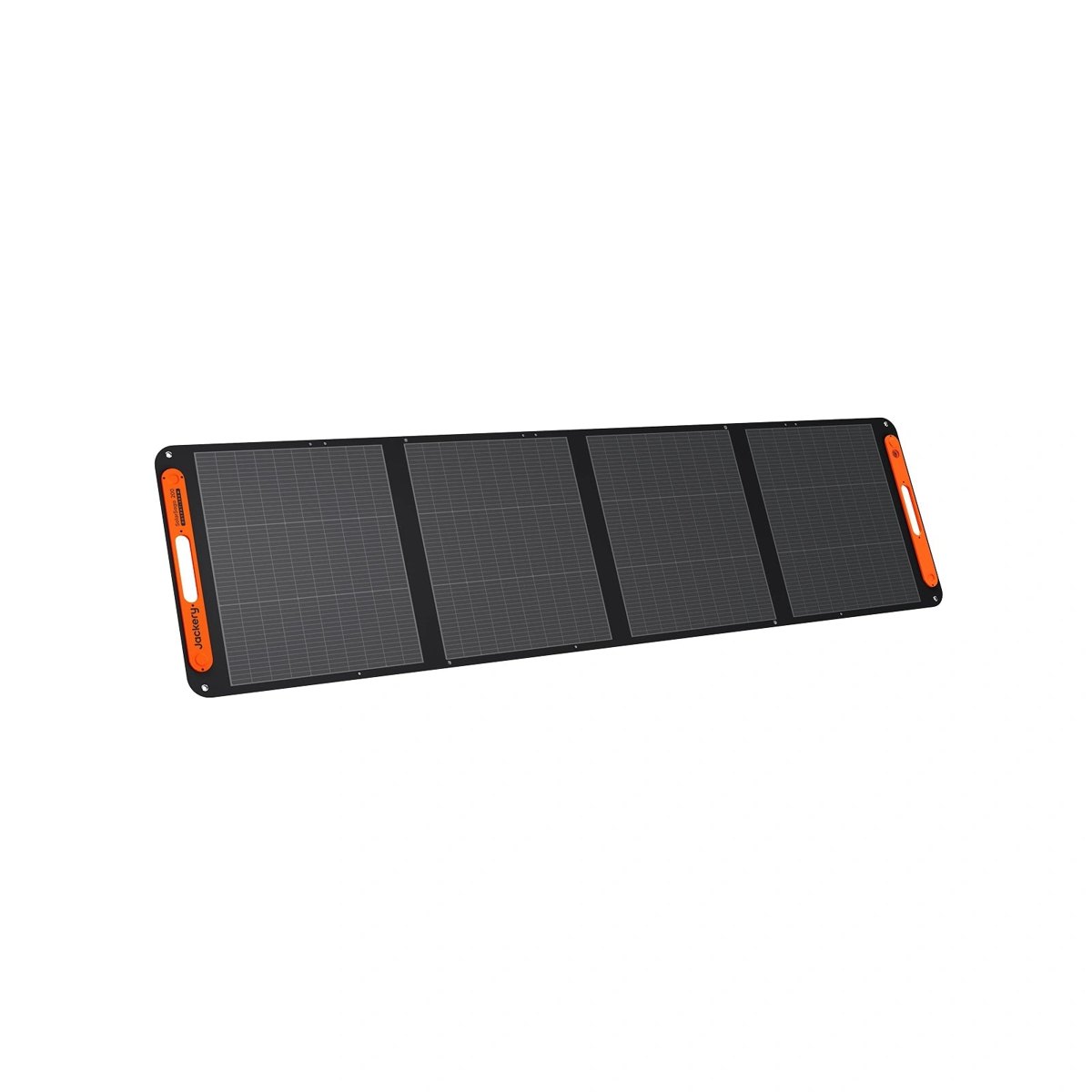
This is the Jackery-native 200 W foldable: bifacial, IP68, proprietary DC8020 cable plus a DC8020→DC7909 adapter in the kit. Jackery’s U.S. tech specs list peak power 200 W ±5%, Voc 22 V ±5%, Isc 12.5 A ±5%, Vmp / Imp 18 V ±5% / 11.5 A ±5%. Maximum system voltage is 60 V. Weight is 14.33 lb ± 0.66 lb. Warranty on the manufacturer page is 3+2 years. The cable also has USB-A 5 V⎓2.4 A and USB-C 5 V⎓3 A for a phone — not for the station. (Jackery SolarSaga 200W tech specs)
Cell marketing conflicts across surfaces. Jackery’s page says Topcon monocrystalline, up to 25% conversion. Amazon feature bullets separately claim IBC and 26.7%. This hub cites both and does not flatten 25% with 26.7%, or Topcon with IBC. Amazon’s technical table “Maximum Voltage: 600 volts” is not Voc. Manufacturer Voc is 22 V; manufacturer max system voltage is 60 V.
BNPI (front 1000 W/m², rear 135 W/m²) is a separate bifacial rating: Pmax 225 W ±5%, Voc still 22 V ±5%. That is not a second STC wattage to add on top of 200 W. The cable is Jackery-native. It will not plug into EcoFlow XT60, Anker XT-60, or BLUETTI MC4 without a separate adapter this listing does not include.
| Claim | Number | Source |
|---|---|---|
| Peak power (STC) | 200 W ±5% | Jackery tech specs |
| Voc / Isc | 22 V ±5% / 12.5 A ±5% | same |
| Vmp / Imp (STC) | 18 V ±5% / 11.5 A ±5% | same |
| BNPI (front 1000 / rear 135 W/m²) | Pmax 225 W ±5%; Voc still 22 V ±5%; Isc 13.5 A ±5%; Imp 12.6 A ±5% | same |
| Max system voltage / reverse current | 60 V / 15 A | same |
| Cell marketing | Mfr: Topcon, up to 25%. Amazon bullets: IBC, 26.7%. Both cited; not flattened. | Jackery page; Amazon feature bullets |
| Weight / size | 14.33 lb ± 0.66 lb (6.5 kg ± 0.3 kg); folded 23.62 × 23.50 × 1.57 in; unfolded 89.76 × 23.50 × 0.98 in | Jackery tech specs |
| Waterproof / operating temp | IP68; −4–149 °F (−20–65 °C) | same |
| Connector | DC8020 for 8.1 mm Jackery DC inputs; DC8020→DC7909 adapter for 8.0 mm Jackery DC inputs. Not MC4. 3 m multi-functional cable with USB-A / USB-C. | Package list on the same page |
| Warranty | 3+2 years | same |
Compatibility vs the six stations (arithmetic on published windows, not a lab test):
| Station | Pair? | Why |
|---|---|---|
| Jackery Explorer 1000 v2 | Yes — native | Dual DC 8 mm, 16–60 V, 400 W max. One panel: Voc 22 V and ~200 W sit inside the window. Two panels, one per DC input: ~400 W at the ceiling. Three panels would exceed 400 W and the panel’s own 60 V max-system-voltage if you series them (3 × 22 V = 66 V). |
| Jackery Explorer 2000 v2 | Yes — native, watt-limited | Same 400 W / dual DC 8 mm ceiling as 1000 v2. One or two panels. Voltage window not re-printed on the 2000 v2 spec pull — confirm on jackery.com before stating 16–60 V for 2000 v2. |
| EcoFlow DELTA 3 | Electrical window OK; connector no | 11–60 V / 500 W would accept 22 V / 200 W. Plug is DC8020, not XT60i. Needs an adapter this kit does not include. |
| Anker SOLIX C1000 Gen 2 | Poor match even with an adapter | Vmp 18 V lands in the 11–28 V / 8.2 A MPPT slice, not the 29–60 V / 14.5 A slice. Imp 11.5 A > 8.2 A, so the station can current-limit a 200 W panel. Connector is still not XT-60/MC4. |
| EcoFlow RIVER 3 | Will clip | 200 W nameplate vs 110 W solar max. Connector still proprietary. |
| BLUETTI AC200L | Electrical window OK; connector no | 22 V / 12.5 A is inside 12–145 V / 15 A / 1200 W. Needs MC4 (or the station’s native PV lead), which this kit does not include. |
Check price on Amazon · Jackery product page
Best EcoFlow-native ~220 W: EcoFlow NextGen 220W Bifacial
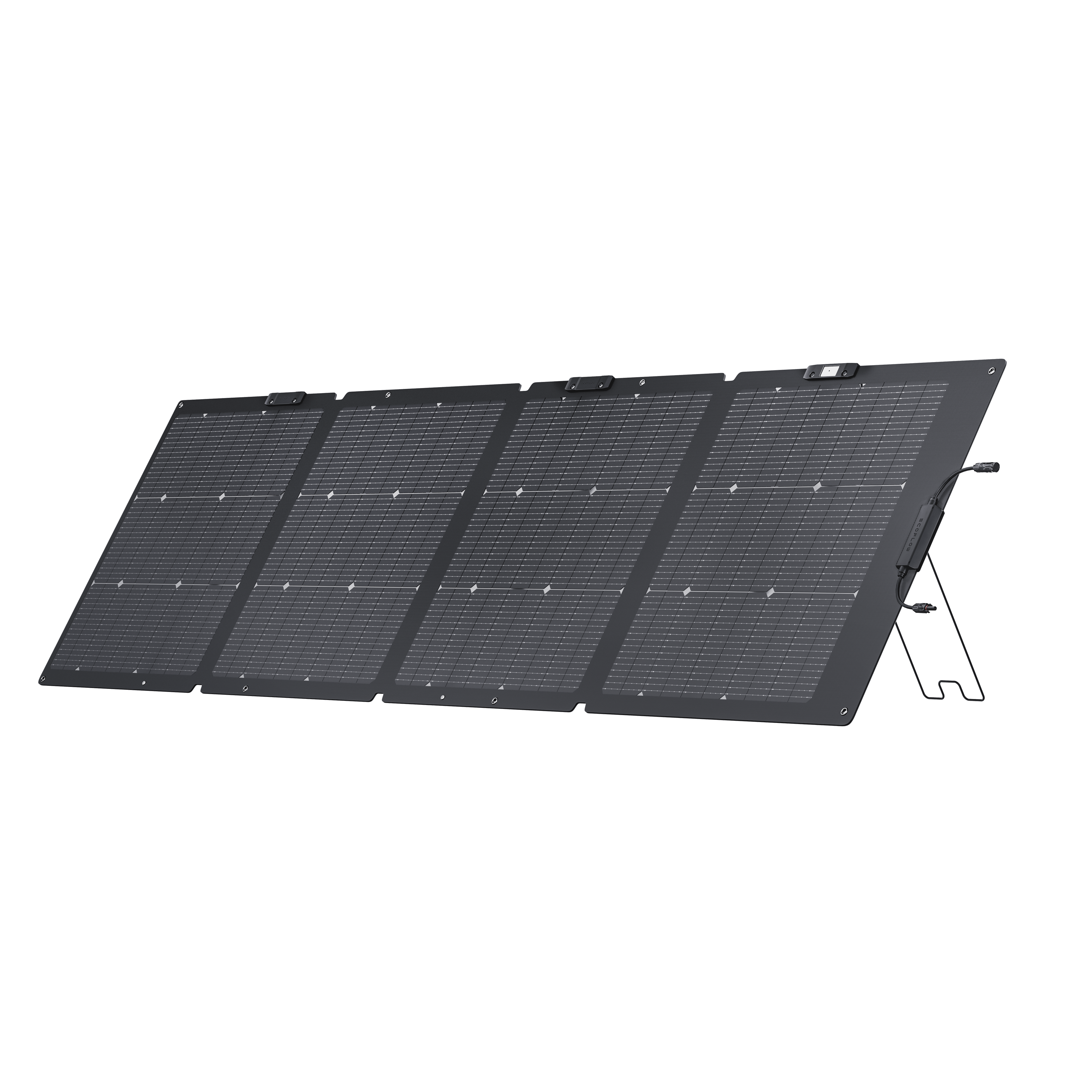
This is the EcoFlow-native ~220 W foldable: N-Type TOPCon, IP68, XT60i charging cable in the box. EcoFlow’s U.S. spec table lists rated power 220 W (±5 W) front / 175 W rear, Voc 21.5 V (Vmp 18.4 V), Isc 12.4 A (Imp 11.9 A) on the front, and about 15.4 lb. Efficiency on that table is 25.00%. U.S. warranty on the spec table is 12 months. Kickstand is an integrated 30–60° stand. (EcoFlow NextGen 220W specs)
Rear-side 175 W is extra only with reflected light (snow, sand, pale ground). Do not add 220 + 175 and call it a 395 W panel. Amazon’s technical table lists connector type MC4 and included components include a Solar to XT60i Charging Cable. EcoFlow’s own spec table says “Photovoltaic connectors.” The XT60i lead is EcoFlow-native; MC4 on the Amazon table is the PV side, not a Jackery DC8020.
| Claim | Number | Source |
|---|---|---|
| Rated power | 220 W (±5 W) front / 175 W rear | EcoFlow specs |
| Cell / efficiency | N-Type TOPCon monocrystalline silicon; 25.00% | same |
| Voc / Vmp | 21.5 V / 18.4 V | same |
| Isc / Imp (front) | 12.4 A / 11.9 A; rear 9.9 A / 9.5 A | same |
| Weight / size | ~15.4 lb (7.0 kg); unfolded 24.2 × 84.8 × 1.0 in; folded 24.2 × 23.2 × 1.3 in | same |
| Connector | Spec table: photovoltaic connectors. In the box: XT60i charging cable. Amazon technical table: MC4 plus that XT60i cable. | EcoFlow specs; Amazon technical details |
| Waterproof | IP68 | EcoFlow specs |
| Kickstand | 30–60° integrated adjustable stand + solar angle guide | same |
| Warranty (US spec table) | 12 months | same |
Compatibility vs the six stations:
| Station | Pair? | Why |
|---|---|---|
| EcoFlow DELTA 3 | Yes — native | 11–60 V / 500 W. One panel: 21.5 V / 220 W. Two in parallel: ~440 W, still under 500 W, Voc stays 21.5 V. Two in series: Voc ~43 V, still under 60 V, ~440 W. Three in series: Voc ~64.5 V over 60 V — do not. |
| EcoFlow RIVER 3 | Will clip | 220 W vs 110 W ceiling. XT60i is the right family of plug, but the station will not take the extra watts. EcoFlow’s own RIVER 3 PDP upsells 45 W / 60 W / 110 W kits for this box. |
| Anker SOLIX C1000 Gen 2 | Electrical maybe; current-window warning | Vmp 18.4 V sits in the 11–28 V / 8.2 A slice. Imp 11.9 A > 8.2 A, so a 220 W panel can be current-limited. Use the XT-60 adapter if the station is XT-60, not a second guess at the port. |
| Jackery 1000 v2 / 2000 v2 | Electrical window likely OK; connector no | 21.5 V is above 1000 v2’s 16 V minimum and under 60 V; ~220 W under 400 W. Needs a PV/XT60i → DC8020 adapter this kit does not include. Do not paste 16–60 V onto 2000 v2. |
| BLUETTI AC200L | Electrical window OK; adapter | 21.5 V / 12.4 A inside 12–145 V / 15 A. One panel is well under 1200 W. Two in parallel would put Isc ~24.8 A over 15 A — series instead (Voc ~43 V, Isc still 12.4 A). Needs MC4 (or the station’s PV lead), not XT60i alone. |
Check price on Amazon · EcoFlow product page
Best Anker-native 400 W: Anker SOLIX PS400
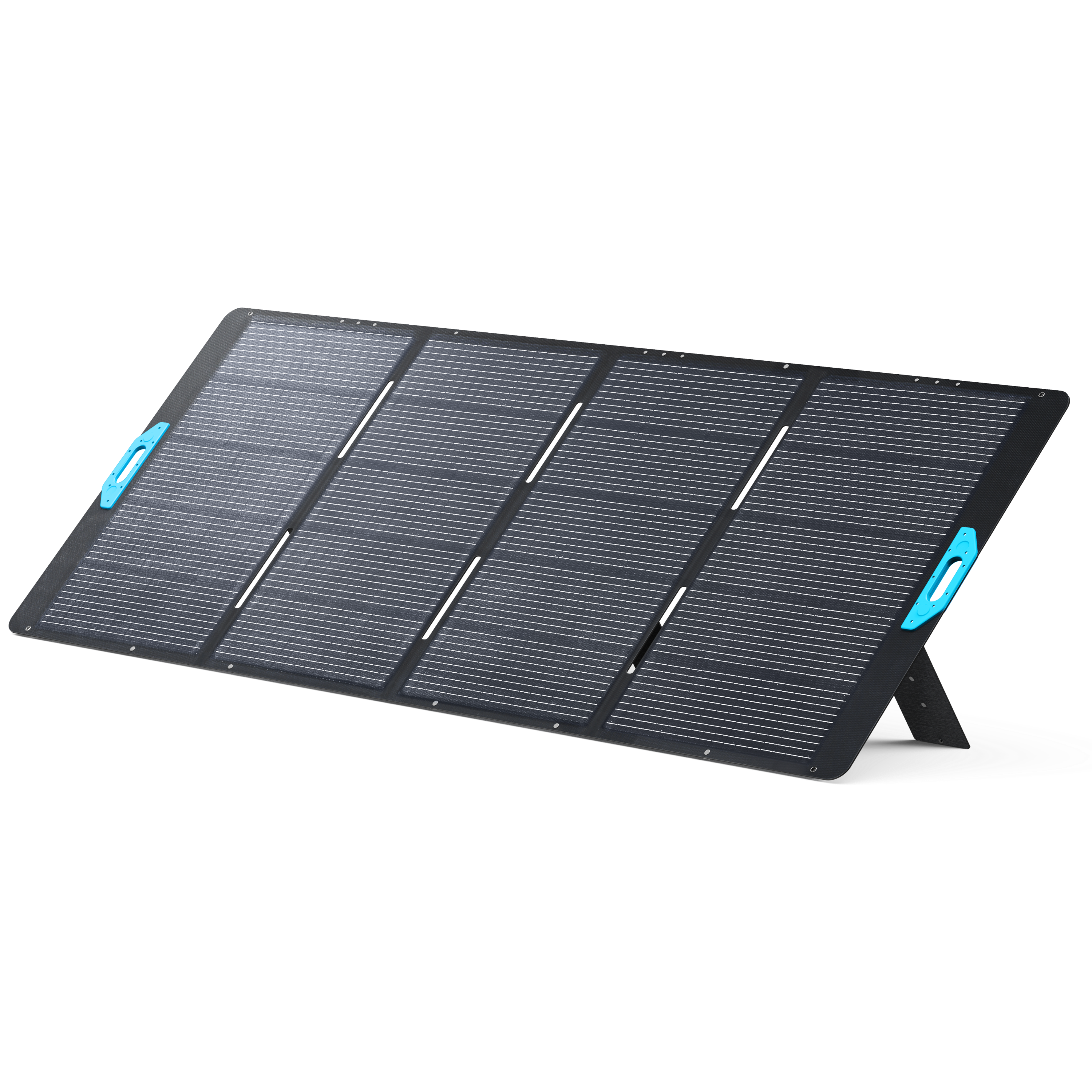
This is the Anker-native 400 W foldable and the only verified 400 W panel in this hub with a printed Voc. Anker’s U.S. specs list maximum output 400 W, Voc 57.6 V, Vmp 48 V, Imp 8.33 A. Net weight is 35.3 lb (Amazon’s technical table listed 35.1 lb — this hub uses the manufacturer 35.3 lb). IP rating is IP67; the FAQ says cover the MC4 ports with the rubber plug before rain. Conversion marketing is up to 23%, monocrystalline. Model on Amazon is A2437. (Anker SOLIX PS400 specs and FAQ)
Isc is not printed on this U.S. spec table. This page does not invent one. What’s in the box, per Anker: the PS400 panel, 2× 9.8 ft (3 m) MC4 solar charging cables, and a 1.6 ft (0.5 m) MC4 to XT-60 solar charging cable. FAQ Q4: MC4 output port. FAQ Q2: “portable power stations with a maximum voltage of up to 60 V and [an] MC4 input port.” They recommend pairing with SOLIX F2000 on that FAQ — that is Anker’s example, not a ban on C1000 Gen 2.
Voc 57.6 V is inside a 60 V station window on paper and tight. Cold-morning Voc is higher than STC Voc (Jackery is the panel in this hub that actually prints a voltage temperature coefficient; Anker’s U.S. PS400 table does not). Do not series two PS400s into any of the 60 V stations (2 × 57.6 V = 115.2 V).
| Claim | Number | Source |
|---|---|---|
| Maximum output | 400 W | Anker SOLIX specs |
| Voc / Vmp / Imp | 57.6 V / 48 V / 8.33 A. Isc not printed on this US table. | same |
| Weight / size | 35.3 lb (mfr; not Amazon’s 35.1 lb); folded 39 × 26.6 × 2 in; unfolded 100 × 39 × 1.2 in | same |
| IP rating | IP67 (FAQ: cover MC4 ports with the rubber plug before rain) | same |
| Kickstand (marketing) | 30° / 40° / 50° / 80° | same |
| Conversion (marketing) | Up to 23%, monocrystalline | same |
| Connector / in the box | MC4 output; 2× 3 m MC4 cables + 0.5 m MC4→XT-60 | FAQ Q4 + what’s in the box |
Compatibility vs the six stations:
| Station | Pair? | Why |
|---|---|---|
| Anker SOLIX C1000 Gen 2 | Yes — intended high-voltage window | Vmp 48 V sits in 29–60 V / 14.5 A. Imp 8.33 A < 14.5 A. 400 W < 600 W. Voc 57.6 V < 60 V. Box includes MC4→XT-60 if that is the station port. Do not parallel two PS400s (Imp ~16.7 A > 14.5 A; 800 W > 600 W). |
| EcoFlow DELTA 3 | Yes electrically, with the XT-60 lead | 400 W < 500 W; 57.6 V < 60 V. Use the included MC4→XT-60 cable. Two panels: 800 W clips at 500 W and 115 V series is over 60 V. |
| Jackery 1000 v2 / 2000 v2 | At the 400 W ceiling; connector no | 400 W is the Jackery max. Voc 57.6 V is under 60 V for 1000 v2. No DC8020 in the box — MC4/XT-60 will not plug into Jackery DC 8 mm without a separate adapter. Do not paste 16–60 V onto 2000 v2. |
| BLUETTI AC200L | Yes electrically via MC4 | 57.6 V and 8.33 A are inside 12–145 V / 15 A / 1200 W. Two in series: Voc ~115 V, still under 145 V, ~800 W, current stays ~8.33 A. Two in parallel: Imp ~16.7 A over 15 A. |
| EcoFlow RIVER 3 | No as a sensible pair | 400 W vs 110 W. Voc 57.6 V — RIVER 3 solar voltage is not printed. Do not recommend this panel for RIVER 3. |
Check price on Amazon · Anker SOLIX product page
Best BLUETTI-native high-watt foldable: BLUETTI 350W (PV350)
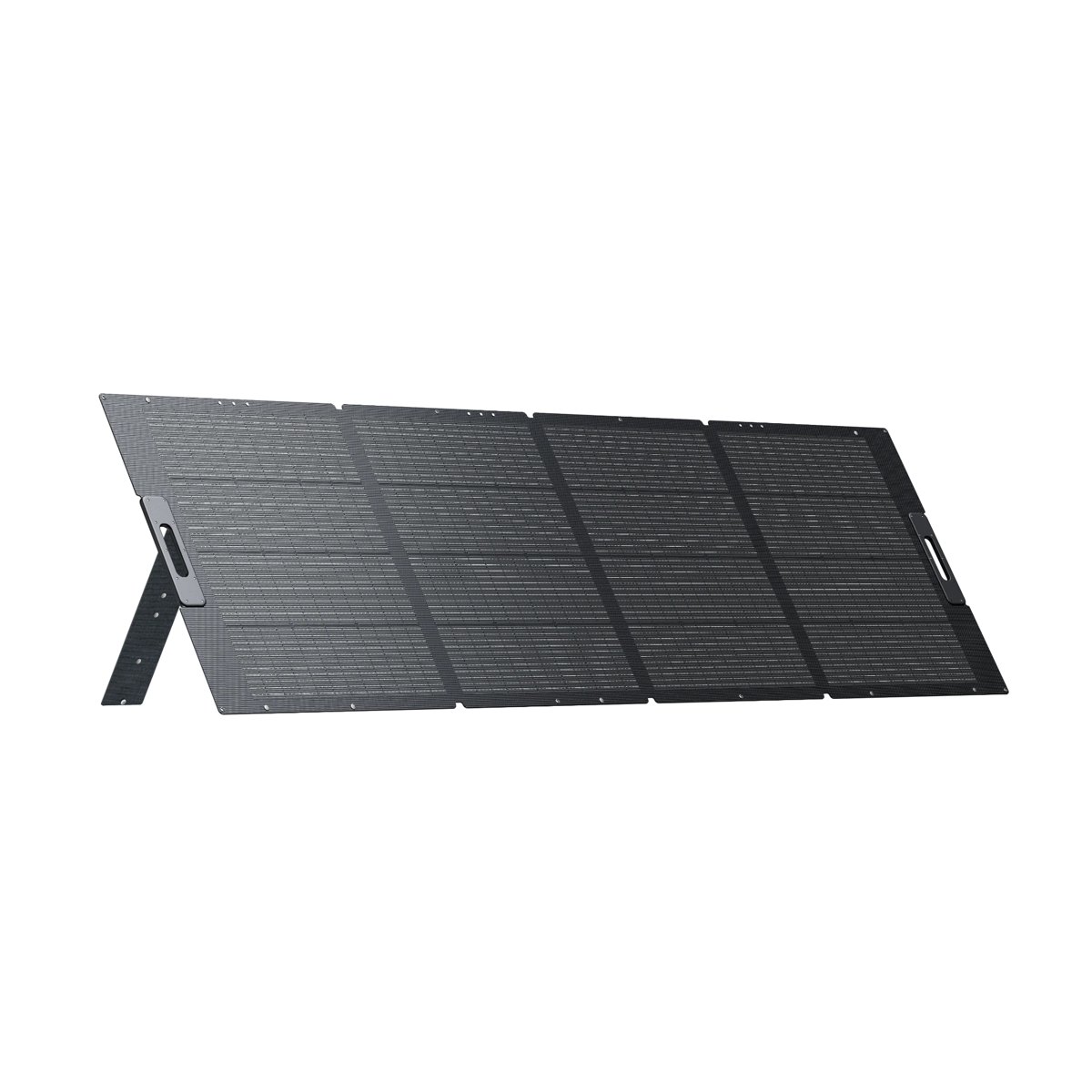
This is the BLUETTI-native high-watt foldable we could verify on a live U.S. Amazon listing (model PV350). Rated power is 350 W. Connector on the manufacturer body is industry-standard MC4. Amazon feature bullets list AC200L among compatible BLUETTI stations. Kickstand: yes. Cell marketing is monocrystalline, up to 23.4%. (BLUETTI 350W product page)
Several claims conflict on BLUETTI’s own surfaces. This hub cites them and does not pick a winner — the same editorial move as the AC200L 7200 W vs 4800 W surge conflict on the generators hub.
- Voc: live U.S. product copy says 33 V open-circuit voltage. Amazon technical details: 46.5 V. An older PV350D spec table indexed from BLUETTI US listed OCV 46.5 V, Vmp 37.5 V, Imp 9.2 A. Publish both 33 V and 46.5 V. Do not treat the older table as a third live Voc for this SKU.
- IP rating: body copy IP67; FAQ on the same U.S. page: “IP65 water-resistant… splash… do not leave it in the rain.” Amazon title IP67. Cite all three.
- Weight / folded size: not printed on the 2026-08-26 U.S. PDP fetch. Amazon technical details: 30.6 lb, folded 35.6 × 24.1 × 2.5 in. Those are Amazon-table figures, not a live manufacturer spec line.
- What’s in the box: U.S. PDP “IN THE BOX” lists the 350 W panel and a 20 A MC4 to XT60 solar charging cable (1.5 m). Amazon “Included Components”: Solar Panel. Do not assume the Amazon carton includes the XT60 lead.
Imp / amperage on Amazon is 9.2 A (matches the older Vmp/Imp table). The live U.S. PDP fetch did not reprint Imp/Isc in the Tech Specs block that loaded.
| Claim | Number | Source |
|---|---|---|
| Rated power | 350 W | Amazon + manufacturer title |
| Voc | 33 V (live US copy) and 46.5 V (Amazon technical details; older PV350D table also 46.5 V). Both cited; not picked. | BLUETTI US page; Amazon technical details |
| Imp / amperage | Amazon 9.2 A (matches older Vmp/Imp table). Not reprinted on the 2026-08-26 US Tech Specs block we fetched. | Amazon technical details |
| Cell | Monocrystalline; Amazon + marketing up to 23.4% | Amazon + mfr marketing |
| Connector | Industry-standard MC4 | Manufacturer body |
| IP rating | Body IP67; FAQ IP65 splash / do not leave in the rain; Amazon title IP67 | Same U.S. page + Amazon title |
| Weight / folded size | 30.6 lb; folded 35.6 × 24.1 × 2.5 in — Amazon technical details, not the live mfr spec line | Amazon technical details |
| In the box | US PDP: panel + 20 A MC4→XT60 (1.5 m). Amazon Included Components: Solar Panel only. | US PDP vs Amazon |
| Compatible list (US PDP) | Includes AC200 L (their spacing) / AC180 / AC70 / Elite 200 V2 and others | Manufacturer page |
Compatibility vs the six stations — use both Voc figures when checking windows:
| Station | Pair? | Why |
|---|---|---|
| BLUETTI AC200L | Yes — native watt-class | 350 W << 1200 W. 33 V and 46.5 V are both inside 12–145 V. 9.2 A < 15 A. MC4 is the BLUETTI panel standard. Three in series: 3 × 46.5 V = 139.5 V (tight to 145 V) or 3 × 33 V = 99 V. BLUETTI’s own solar-panels FAQ example used a 43.8 V / 10.1 A 350 W panel to illustrate three in series on AC200L — that is a worked example, not a third Voc to invent as this SKU’s spec. |
| EcoFlow DELTA 3 | Maybe — Voc-dependent | 350 W < 500 W. If Voc is 33 V, under 60 V. If Voc is 46.5 V, also under 60 V. Two in series: 2 × 46.5 V = 93 V over 60 V. Connector: MC4 / optional XT60 lead vs EcoFlow XT60i — confirm the lead in the actual carton. |
| Anker SOLIX C1000 Gen 2 | Window depends on Vmp | 350 W < 600 W. If the panel operates near 37.5 V, that is the 29–60 V / 14.5 A slice (good). If it operates near 33 V Voc / lower Vmp, it may sit near the 28/29 V split — re-check Vmp on the live table before stating the slice. Imp 9.2 A is under 14.5 A. |
| Jackery 1000 v2 / 2000 v2 | 350 W under 400 W; connector no | Needs DC8020. 46.5 V < 60 V (1000 v2). Do not paste 16–60 V onto 2000 v2. |
| EcoFlow RIVER 3 | No as a sensible pair | 350 W vs 110 W. |
Check price on Amazon · BLUETTI product page
Best documented third-party 200 W: Renogy E.Flex 200W
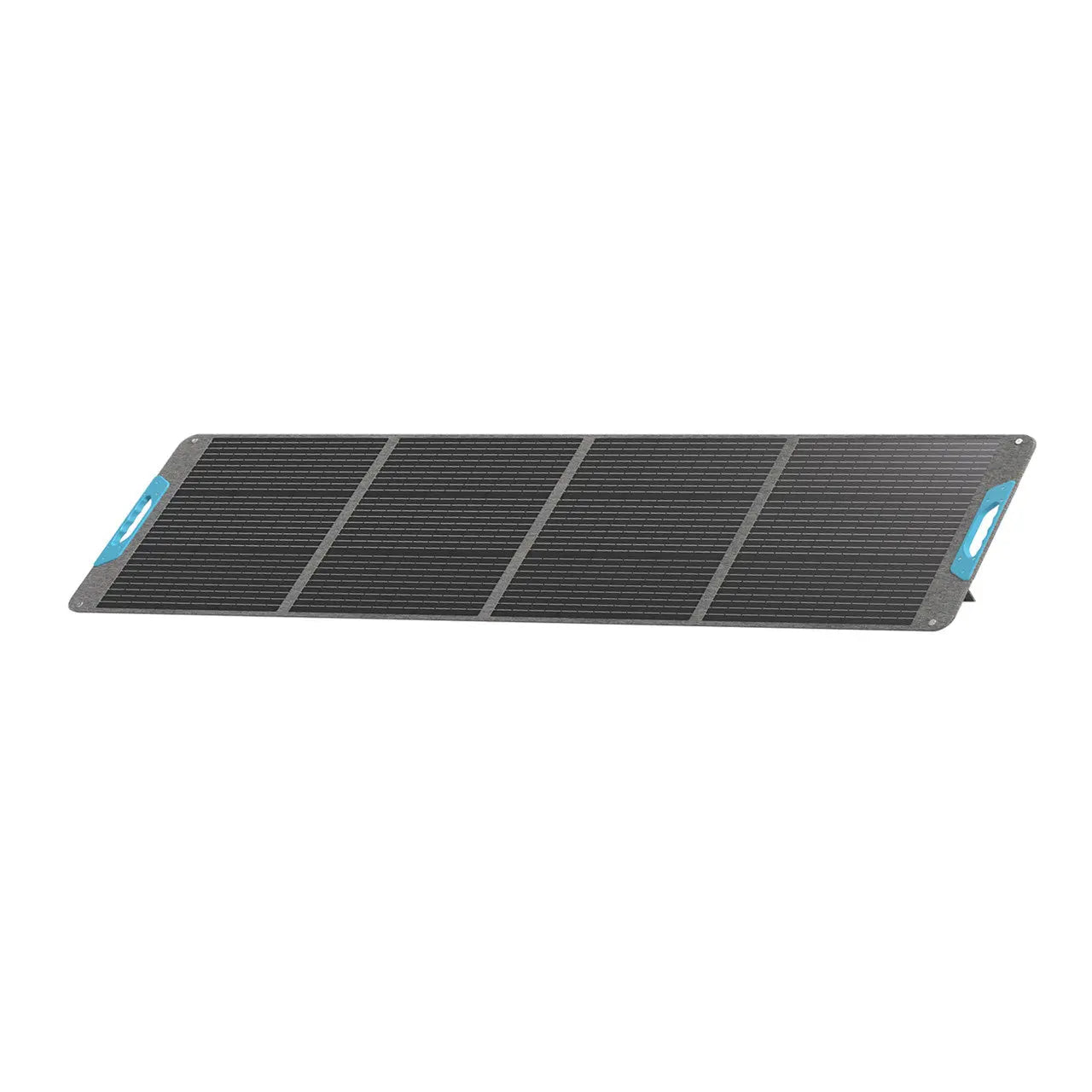
This is the third-party 200 W foldable in the lineup because Voc is documented. Use only the “200W Portable Solar Panels” spec table on Renogy’s U.S. page: max power 200 W, Voc 21.6 V, Isc 11.3 A, Vmp 18.8 V, Imp 10.6 A, weight 13.89 lb / 6.3 kg, IP65, cell efficiency >25%. Operating temperature 14 °F to 149 °F (−10 °C to +65 °C). The same PDP also sells a 100 W variant. The Shopify body also contains a 23.40 V open-circuit line on the combined 100/200 W product record. Do not use 23.40 V for the 200 W SKU. The on-page 200 W table is 21.6 V and matches Amazon’s 21.6 V. (Renogy E.Flex 200W table)
Connector is not named on the 200 W spec table. Amazon technical details: MC4, USB. Amazon bullets describe USB-C PD (45 W max) + two USB-A (18 W and 15 W) + MC4 to a power station / 12 V battery (controller not in the panel). Label USB/MC4 as Amazon-table + bullets, not as a printed manufacturer electrical line. IP65 is splash, not the IP67/IP68 ratings on the brand panels above. Jackery and EcoFlow still need adapters. Wattage still has to fit each station.
| Claim | Number | Source |
|---|---|---|
| Max power at STC | 200 W | Renogy 200 W table |
| Voc / Isc | 21.6 V / 11.3 A (not the 23.40 V combined-record line) | same |
| Vmp / Imp | 18.8 V / 10.6 A | same |
| Cell efficiency | >25% (page marketing: N-Type / 16BB on Amazon bullets) | Renogy table; Amazon bullets |
| Weight / size | 13.89 lb / 6.3 kg; folded 23.72 × 22.99 × 1.97 in; unfolded 87.80 × 22.99 × 0.12 in | Renogy 200 W table |
| Waterproof / operating temp | IP65; 14 °F to 149 °F | same |
| Connector | Not named on the 200 W spec table. Amazon technical details: MC4, USB. | Amazon technical details + bullets |
Compatibility vs the six stations:
| Station | Pair? | Why |
|---|---|---|
| BLUETTI AC200L | Yes electrically (MC4) | 21.6 V / 11.3 A / 200 W inside 12–145 V / 15 A / 1200 W. Parallel two: Isc ~22.6 A over 15 A — series instead (Voc ~43.2 V). |
| EcoFlow DELTA 3 | Yes electrically (needs XT60) | 21.6 V / 200 W inside 11–60 V / 500 W. Two parallel ~400 W under 500 W. No XT60 in the Renogy spec table — buyer supplies the MC4→XT60i lead. |
| Jackery Explorer 1000 v2 | Yes electrically (needs DC8020) | 21.6 V is above 16 V min; 200 W under 400 W; Isc 11.3 A under 21 A. Not a Jackery cable. |
| Jackery Explorer 2000 v2 | Watt OK; confirm voltage; connector no | 200 W < 400 W. Voltage window not on the 2000 v2 spec pull. |
| Anker SOLIX C1000 Gen 2 | Same low-window warning as other ~18 V panels | Vmp 18.8 V → 11–28 V / 8.2 A slice. Imp 10.6 A > 8.2 A, so a 200 W panel can be current-limited. |
| EcoFlow RIVER 3 | Will clip | 200 W vs 110 W. |
Check price on Amazon · Renogy product page
Connector cheat sheet
Do not mix families without an adapter. An adapter is a separate SKU unless the panel listing’s box list names it.. Full explainer: Wrong Plug, Right Watts: Power Station Connectors
| Family | Who ships it (of these five) | Plugs into (of the six stations) without a third-party adapter |
|---|---|---|
| Jackery DC8020 / DC7909 (8.1 / 8.0 mm) | SolarSaga 200W kit | Explorer 1000 v2 and 2000 v2 only |
| EcoFlow XT60 / XT60i | NextGen 220W kit (XT60i in the box) | DELTA 3 and RIVER 3 (still respect watt ceilings) |
| MC4 | Anker PS400; BLUETTI 350W; Renogy (Amazon table) | AC200L’s PV input as BLUETTI documents it; Anker if the station is MC4. PS400 also includes MC4→XT-60 |
| USB-A / USB-C on the panel | Jackery cable; Renogy (Amazon) | Phones/tablets only — this is not the power-station solar input |
Industry MC4 is not Jackery DC8020. XT60i is not MC4.
First-choice panel for each station
Recommended first panel for each station already on the Best Solar Generators hub. Not a promise that field watts equal STC watts.
| Station | First-choice panel | Why | Do not |
|---|---|---|---|
| EcoFlow DELTA 3 (500 W, 11–60 V) | EcoFlow NextGen 220W, or two of them in parallel | Native XT60i; 220 W or ~440 W under 500 W; Voc 21.5 V | Series three 220 W (Voc ~64.5 V). Do not use PS400 in series pairs. |
| Anker SOLIX C1000 Gen 2 (600 W, split 11–28 V / 29–60 V) | Anker SOLIX PS400 | Vmp 48 V uses the high 29–60 V / 14.5 A window; 400 W < 600 W; adapter in the box | A single 18–22 V 200 W panel (Jackery / EcoFlow 220 / Renogy) lands in the 8.2 A low window and can clip. Do not parallel two PS400s. |
| Jackery Explorer 1000 v2 (400 W, 16–60 V, dual DC 8 mm) | Jackery SolarSaga 200W, one or two | Native DC8020/DC7909; 22 V; two panels fill 400 W | A third SolarSaga. MC4 panels without a DC8020 adapter. |
| Jackery Explorer 2000 v2 (400 W, dual DC 8 mm) | Same SolarSaga 200W, one or two | Same 400 W ceiling as 1000 v2 — more battery, not more solar headroom | Expecting 2000 v2 to take a 400 W Anker and a second panel. Confirm voltage on the 2000 v2 PDP if you state a volt window. Do not copy 16–60 V from 1000 v2. |
| EcoFlow RIVER 3 (110 W) | None of the five verified panels is a clean match | Every included panel is 200–400 W STC. RIVER 3’s own PDP bundles 45 W / 60 W / 110 W panels. Solar Voc is not printed on the RIVER 3 spec table | Do not imply a 200 W+ foldable is “sized for RIVER 3.” It will clip at 110 W if it connects at all. |
| BLUETTI AC200L (1200 W, 12–145 V, 15 A) | BLUETTI 350W, up to a few in series not parallel | Native MC4; 350 W leaves headroom; 15 A caps parallel current | Parallel two ~11–12 A panels (Isc sum > 15 A). Series enough 46.5 V panels to approach 145 V without checking the live Voc (cite both 33 V and 46.5 V). |
Practical notes
STC watts are not field watts
Angle, temperature, wire, soiling, and the station’s MPPT window all cut output. A station clips any array above its watt ceiling whether the extra watts are real or only on the sticker. Jackery’s own SolarSaga page still treats charge-time figures as lab data. Do not treat kit marketing watts as field output. For station sizing in watt-hours — fridge, CPAP, a 24-hour kit — see How Much Solar Generator Do I Need?
Match three numbers, not the logo
(1) Panel STC watts vs station solar-max watts. (2) Panel Voc vs station volt window — series adds Voc, and cold sun raises Voc. (3) Panel current vs station amp window — parallel adds current. The 60 V club here is DELTA 3, C1000 Gen 2, and Jackery 1000 v2. PS400 at 57.6 V Voc is tight on that club. The ~22 V 200 W class is loose on volts and can still lose watts on C1000 Gen 2’s 8.2 A low-voltage slice.
Proprietary vs industry connectors
Jackery DC8020/DC7909 stays in the Jackery family. EcoFlow XT60i stays in the EcoFlow family unless you add a lead. MC4 is the cross-brand default in this hub (BLUETTI, Anker PS400, Renogy Amazon table) and still has to pass Voc/Isc. USB ports on a panel are for a phone.
RIVER 3 is the mismatch on purpose
None of the five verified current-gen foldables in this hub is sized to a 110 W ceiling. That is a finding, not an omission to paper over with a 200 W “it’ll just clip” recommendation.
Conflicts we did not flatten
- Jackery SolarSaga: manufacturer 25% / Topcon vs Amazon 26.7% / IBC.
- BLUETTI 350W: Voc 33 V vs 46.5 V; IP IP67 vs IP65; U.S. PDP carton lists MC4→XT60, Amazon Included Components lists the panel only.
- Renogy 200 W Voc is 21.6 V on the 200 W table. Ignore 23.40 V on the combined 100/200 W product record.
- Anker PS400 weight is manufacturer 35.3 lb, not Amazon’s 35.1 lb. Isc is unpublished on the U.S. table.
- Jackery Explorer 2000 v2 solar voltage window stays unpublished on the spec pull this site used. Do not copy 16–60 V from 1000 v2.
- RIVER 3 solar voltage stays unpublished. Do not copy 11–30 V from the car input.
Do not copy EcoFlow/Anker “4000 cycles to 80%” language onto panels — those cycle lines are battery-station claims.
Specs and Amazon.com listings checked August 26, 2026. Station solar ceilings checked August 25, 2026. This page does not include prices. Confirm the live listing and the current manufacturer spec table before you buy.
How we sourced this
This is a spec hub, not a hands-on review. We have not lab-tested these panels, timed a charge on a station, or lived with them in the field. Watts, Voc, current, weights, IP ratings, and connector claims below come from manufacturer spec pages (and, where the maker’s table is silent, from the live Amazon.com technical details). Amazon.com listings were checked as live U.S. product pages on August 26, 2026. Station solar ceilings are from the Best Solar Generators hub (checked August 25, 2026). Re-open any listing before you buy — stock and titles change. No prices on this page.
Disclosure: As an Amazon Associate I earn from qualifying purchases. Some links are affiliate links. You pay the same.