Disclosure: As an Amazon Associate I earn from qualifying purchases. Some links are affiliate links. You pay the same.
This is a brand × use-case page, not a second “best solar generators 2026” spreadsheet. Four jobs, one verified suitcase per job, plus the compact high-output Anker already on the generators hub. For the six-station capacity / output / weight table, see Best Solar Generators / Portable Power Stations (2026). For watt-hours vs watts and fridge math, see How Much Solar Generator Do I Need? For Voc, connectors, and first-choice foldables, see Best Portable Solar Panels for Power Stations (2026).
Jackery, EcoFlow, BLUETTI, and Anker do not make interchangeable boxes. Warranties are channel-dependent. Extra batteries are brand-proprietary. Jackery DC8020 is not EcoFlow XT60i is not industry MC4. Cycle ratings to 70%+ are not the same claim as 80%. Where two manufacturer pages disagree, this hub cites both and does not pick a winner. A 2026 portable bought and placed in service in 2026 does not get a 30% Residential Clean Energy Credit — see the ITC note below.
- Use-case matrix
- Quick comparison
- Quiet camping: Jackery Explorer 1000 v2
- Compact high output (not expandable): Anker SOLIX C1000 Gen 2
- Fridge overnight: Jackery Explorer 2000 v2
- Expandable home / cabin: BLUETTI AC200L
- 240 V workshop: EcoFlow DELTA Pro 3
- Brand differences (warranty, expandability, solar, 240 V, quiet)
- LiFePO4 cycles and leftover NMC SKUs
- No 30% ITC on 2026 portables
- Practical notes (refurb, panels, electrician jobs)
Use-case matrix
Arithmetic uses named kWh/day figures already on How Much Solar Generator Do I Need? — a DOE FEMP ENERGY STAR fridge example of ≈ 1.0 kWh/day, and an ORNL representative 1.5–2.0 kWh/day. This site has not timed a compressor. Inverter losses and surge are not included. Numbers in the product sections are manufacturer claims unless noted.
Not sure which row is yours? Run your devices through our portable power station size calculator, then match the result to the table below.
| Job | Capacity you actually need | Pick | Will not do |
|---|---|---|---|
| Quiet camping (phones, lights, laptop, small camp fridge — not a household fridge) | ~1 kWh / 1500 W class; carryable | Jackery Explorer 1000 v2 | Multi-day house fridge; 240 V tools |
| Fridge overnight (full-size household fridge, maybe router + LEDs) | ~2 kWh class | Jackery Explorer 2000 v2 | 48-hour fridge+HVAC; 240 V well pump |
| Expandable home / weekend cabin (grow later, more solar in) | ~2 kWh now, path past 4–8 kWh | BLUETTI AC200L | 240 V split-phase; grab-and-go at 62.4 lb |
| 240 V workshop (welder, dryer, well-pump class — still not a hardwired house) | 4 kWh+ and a 240 V outlet on the box | EcoFlow DELTA Pro 3 | Simultaneous 120 V + 240 V on this SKU (EcoFlow FAQ: no). Transfer-switch install is an electrician job. |
This page compares four station brands. If you want a DIY plan you download and build, see Energy Revolution System plans.
Camping alt (not the pick): Anker SOLIX C1000 Gen 2 — 24.9 lb, 2000 W, 600 W solar, not expandable. Use if inverter headroom matters more than Jackery’s native SolarSaga cable. Full spec card below; it is already the compact high-output slot on the generators hub.
Expandable alt at ~1 kWh (not the pick): EcoFlow DELTA 3 — claimed expansion to 5 kWh, but the base pack is still one efficient-fridge-day. Specs live on the generators hub.
Ultralight day-trip (not a camping-fridge pick): EcoFlow RIVER 3 — 245 Wh / 300 W / 7.8 lb. Will not run a household fridge or an all-night humidifier CPAP. The Amazon title still garbles capacity as “245W”; use the manufacturer 245 Wh. Specs on the generators hub.
Quick comparison
The four job picks plus the compact high-output Anker. No prices — check the live Amazon listing. None of these is a whole-house hardwired system.
| Job | Model | Capacity | AC continuous | Solar max | Weight | Expandable? | 240 V on the box? |
|---|---|---|---|---|---|---|---|
| Quiet camping | Jackery Explorer 1000 v2 | 1070 Wh | 1500 W | 400 W | 23.8 lb | No | No (120 V) |
| Compact high output (not the camping pick) | Anker SOLIX C1000 Gen 2 | 1,024 Wh | 2,000 W | 600 W | 24.9 lb | No | No (120 V) |
| Fridge overnight | Jackery Explorer 2000 v2 | 2042 Wh | 2200 W | 400 W | 39.5 lb | No | No (120 V) |
| Expandable home / cabin | BLUETTI AC200L | 2048 Wh | 2400 W | 1200 W | 62.4 lb | Yes (to 8192 Wh claimed) | No split-phase (TT-30 is 120 V) |
| 240 V workshop | EcoFlow DELTA Pro 3 | 4096 Wh | 4000 W | 2600 W total | 113.54 lb | Yes (12 kWh single-unit / 36–48 kWh system footnotes — do not collapse) | Yes — L14-30 + 6-20R; not simultaneous with 120 V |
Sources: Jackery Explorer 1000 v2, Anker SOLIX C1000 Gen 2, Jackery Explorer 2000 v2, BLUETTI AC200L, EcoFlow DELTA Pro 3. Chemistry for Jackery, BLUETTI, and EcoFlow is printed on the manufacturer spec table as LFP / LiFePO4. Anker’s fetched spec tables did not print the word “LiFePO4”; that chemistry is from the Amazon title plus a 4,000-cycle claim — see the Anker section. Cycle end-of-test percentages are not the same across brands — see cycles.
Quiet camping: Jackery Explorer 1000 v2
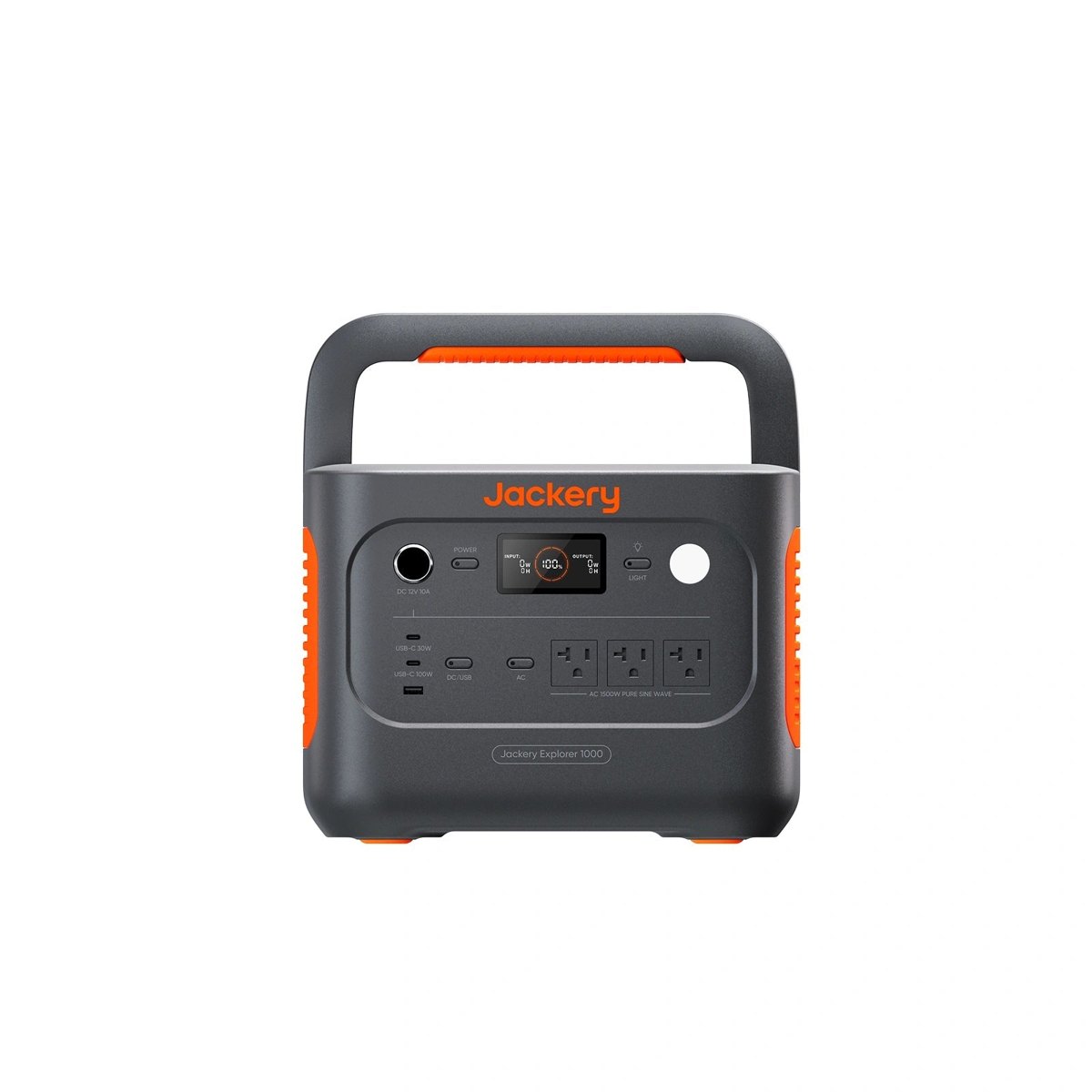
For a carryable ~1 kWh camp box — phones, lights, a laptop, a small camp fridge, not a household fridge — Explorer 1000 v2 is the pick because it is the lightest verified ~1 kWh station here at about 23.8 lb, with a native Jackery SolarSaga DC8020 / DC7909 path. Jackery’s product copy calls it the “World’s smallest and lightest 1kWh LFP” and “At 30 dB, it’s as quiet as a whisper.” Those are manufacturer claims; this site has not metered the fan. Specs: 1070 Wh, 1500 W continuous / 3000 W surge, LiFePO4, solar 400 W max (dual DC 8 mm, 16–60 V, dual to 21 A), cycle rating 4000 cycles to 70%+ (not 80%), UPS ≤20 ms, not expandable. Pair with Jackery SolarSaga 200W from the portable panels hub. (Jackery Explorer 1000 v2 tech specs)
Warranty conflict — cite both, do not tell Amazon shoppers they automatically get five years. Product Tech Specs and FAQ (re-opened 27 Aug 2026): 3+2 years. FAQ: “3 years standard warranty and 2 years extended warranty… only… official Jackery website, Jackery-branded third-party platforms, or local authorized dealers.” Hero copy: “3-Year Warranty + 2 Extra Years Free — Exclusively at jackery.com.” Jackery Service Policy (updated 20 Aug 2026): 2+1 years for “1500 Series/1000 Series/500 Series/300 Series/240 Series/160 Series.” Extra years are channel-dependent.
Caveat: lower AC and solar headroom than C1000 Gen 2 (2000 W / 600 W) or DELTA 3 (1800 W / 500 W, expandable). 1500 W / 120 V will not run a 240 V tool. Do not copy EcoFlow/Anker “to 80%” wording onto this pack.
| Claim | Number | Source |
|---|---|---|
| Chemistry | LiFePO4 | Jackery tech specs |
| Capacity | 1070 Wh (30.4 Ah / 35.2 V) | same |
| AC output | 1500 W continuous / surge 3000 W | same |
| Solar input | Dual DC 8 mm, 400 W max, 16–60 V working voltage, dual to 21 A | same |
| Weight / size | ~23.8 lb / 10.8 kg; 12.87 × 8.82 × 9.72 in | same |
| Ports | USB-C 30 W + 100 W, USB-A 18 W, car 12 V/10 A, plus AC | same |
| Quiet (mfr copy, not metered here) | 30 dB | Product page |
| Cycle rating | 4000 cycles to 70%+ (not 80%) | Tech specs |
| UPS / transfer | ≤20 ms | same |
| Expandable | No | same |
| Warranty | Product 3+2 (extra years official / Jackery-branded / authorized, “exclusively at jackery.com”); Service Policy 2+1 for 1000 Series — conflicting manufacturer figures, both cited | Product PDP + Jackery Service Policy (updated 20 Aug 2026) |
Check price on Amazon · Jackery product page
Compact high output (not expandable): Anker SOLIX C1000 Gen 2
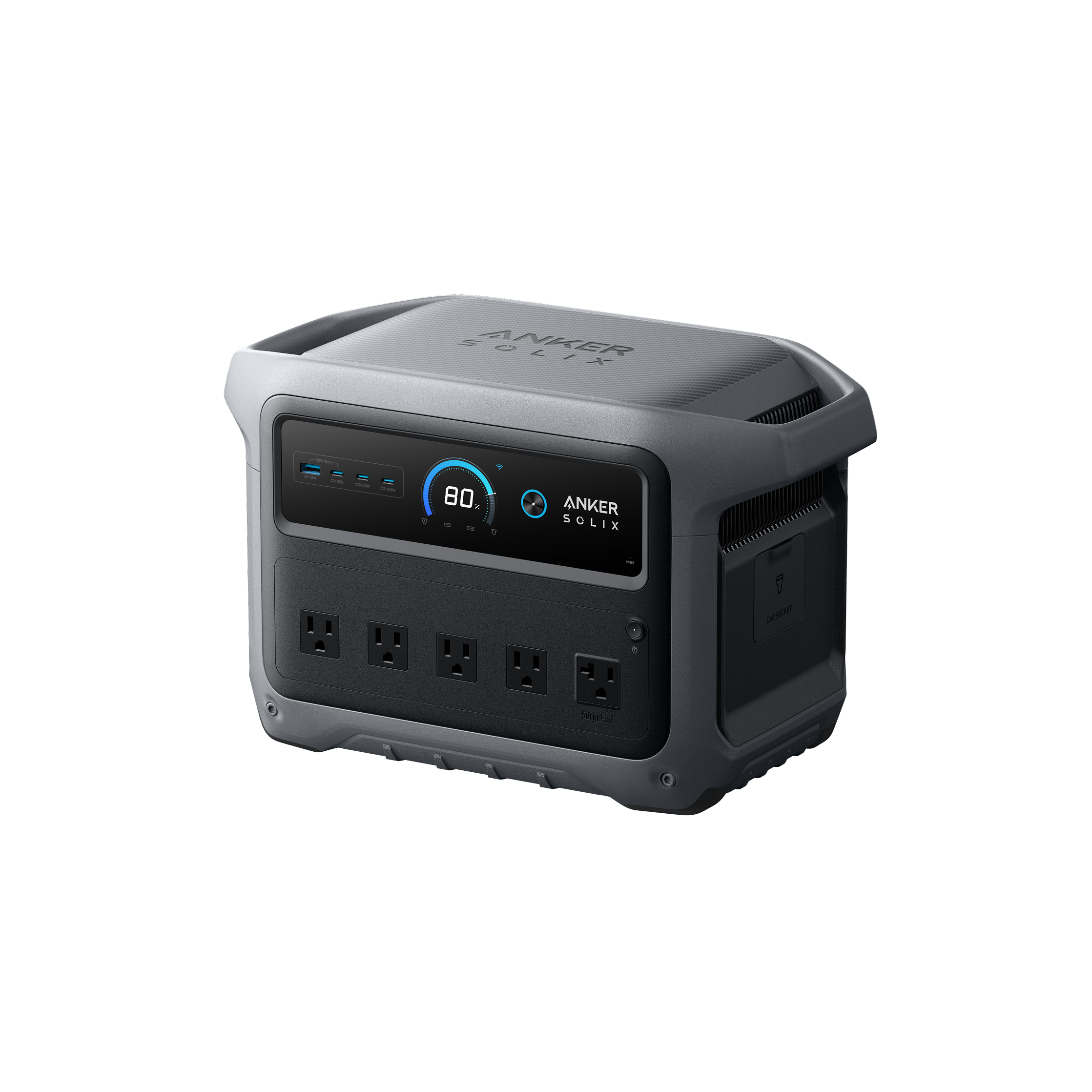
This is not the quiet-camping pick. It is the compact high-output ~1 kWh box already on the generators hub: model A1763, 1,024 Wh, 2,000 W continuous AC, and the highest solar-input ceiling in this size class at 600 W max, at 24.9 lb. Use it when inverter headroom (and the 600 W MPPT) matter more than Jackery’s native DC8020 cable. Anker claims a full charge in 49 minutes via 1,600 W UltraFast AC (1,200 W is the standard AC-charge figure). UPS transfer is listed at 10 ms. (Anker SOLIX C1000 Gen 2; A1763 user guide)
Two numbers you should not mash together: the product page and Amazon title list a 3,000 W peak; the user guide separately lists SurgePad up to 2,400 W. Those are different claims. This page cites both and does not pick a winner.
Chemistry: the Amazon title states LiFePO4. The manufacturer spec tables we fetched did not print the word “LiFePO4.” Treat it as Amazon-title chemistry plus Anker’s 4,000 cycles to ≥80% claim, not as a printed manufacturer chemistry line.
It is not expandable. Anker’s comparison table lists Expandable Capacity = No for C1000 Gen 2 (the original C1000 is the Yes). The same product page also offers a bundle named “Anker SOLIX C1000 + Expansion Battery” without “Gen 2” in that option name — that is the original expandable C1000 upsell, not evidence that Gen 2 takes extra batteries. ~1 kWh is therefore a hard ceiling, and it is short for multi-day home backup.
Solar window is split MPPT: 11–28 V 8.2 A and 29–60 V 14.5 A (600 W max). Anker SOLIX PS400 (first-choice panel on the panels hub) uses the high window (Vmp 48 V). A ~18 V 200 W panel lands in the 8.2 A slice and can clip. See Best Portable Solar Panels.
| Claim | Number | Source |
|---|---|---|
| Chemistry | Amazon title: LiFePO4. Fetched manufacturer spec tables did not print that word. | Amazon title; cycle claim on Anker product page |
| Capacity | 1,024 Wh | Anker product page |
| AC output | 2,000 W continuous, 3,000 W peak | Amazon title + product page |
| SurgePad | Up to 2,400 W (not the same number as the 3,000 W peak) | A1763 user guide |
| Solar input | 600 W max. Live specs: MPPT 11–28 V 8.2 A; 29–60 V 14.5 A (600 W max) | Product-page specs table |
| AC charge | 1,200 W standard / 1,600 W UltraFast; claimed full charge in 49 min | Product page |
| Weight / size | 24.9 lb / 11.3 kg; 15.12 × 8.19 × 9.61 in | Product page |
| Ports | USB-C2/C3 140 W, USB-C1 15 W, USB-A 12 W (A+C1 total 20 W), car 12 V/10 A/120 W, plus AC | Product page / user guide |
| Cycle rating | 4,000 cycles to ≥80% | Product page |
| UPS / transfer | 10 ms | Product page |
| Expandable | No (manufacturer comparison table) | Product page |
| Warranty | Registration page: registering “Activates 5-year hassle-free protection” for Anker SOLIX portable power stations; C1000 Gen 2 is on the product list | Anker SOLIX warranty registration |
Check price on Amazon · Anker SOLIX product page
Fridge overnight: Jackery Explorer 2000 v2
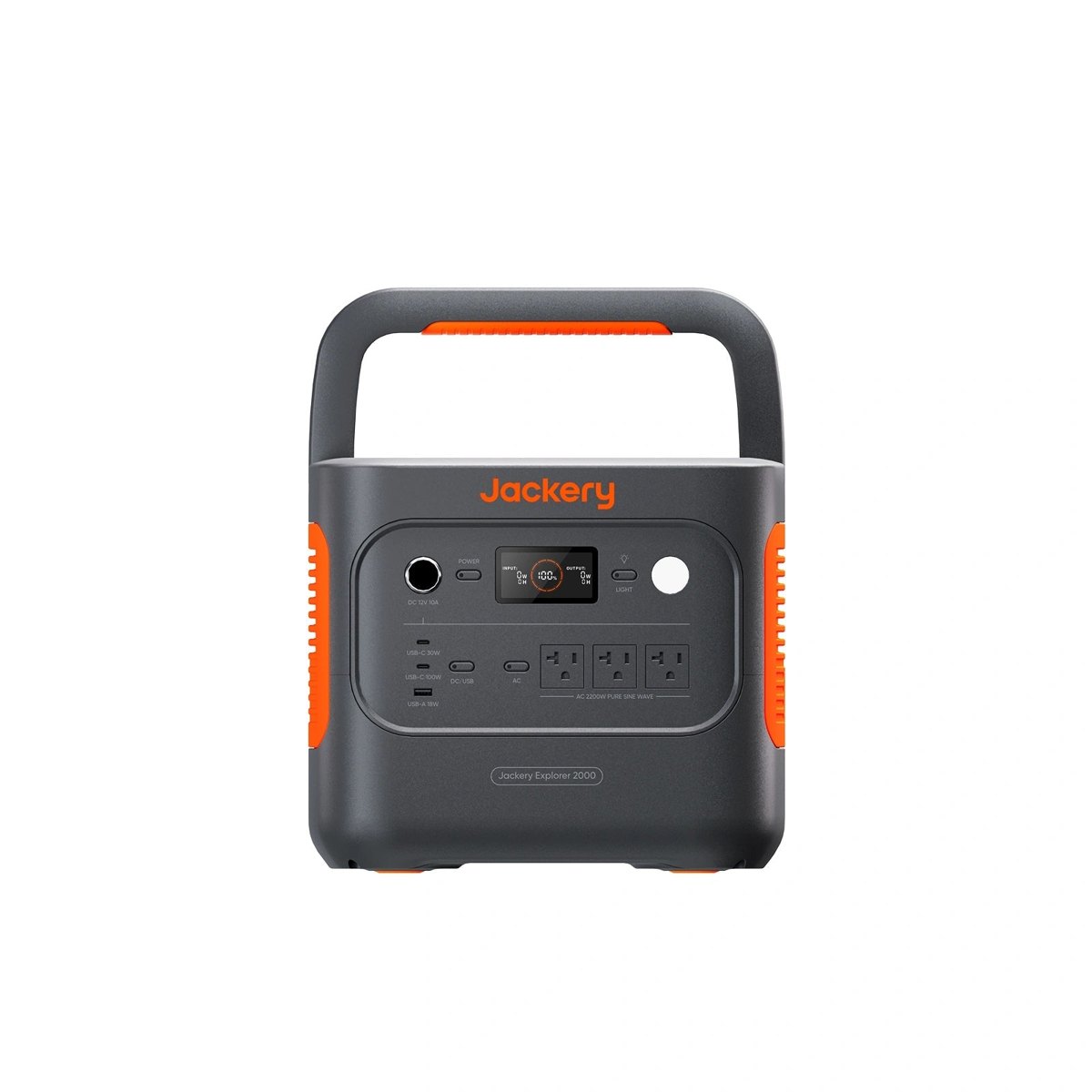
For a full-size household fridge overnight (maybe a router and LEDs), Explorer 2000 v2 is the pick because 2042 Wh is the lighter of the two verified ~2 kWh boxes here (39.5 lb vs AC200L 62.4 lb). Sizing-hub arithmetic: ~2 kWh is closer to one typical older-fridge day (ORNL 1.5–2.0 kWh/day) than the 1 kWh class — not a 48-hour kit, and inverter losses plus compressor surge are not included. AC is 2200 W continuous / 4400 W surge. Jackery copy: indoor-friendly, <30 dB quiet mode / 45 dB full load (measured 1 m; Data Note on the PDP). This site has not metered it. LiFePO4. Cycle rating 4000 cycles to 70%+. UPS <20 ms. Manufacturer FAQ: not expandable — Jackery points expandable buyers at Solar Generator 2000 Plus; that Plus SKU is not verified as an Amazon pick in this page, so it is not an ASIN here. (Jackery Explorer 2000 v2 tech specs and FAQ)
Solar voltage is not a copy of 1000 v2. Jackery Tech Specs re-opened 27 Aug 2026 now print the 2000 v2 window (the generators-hub pull had it unpublished). Dual DC 8 mm, 400 W max. Working voltage: 11–16 V 8 A (double to 8 A) and 16–60 V 12 A (double to 21 A / 400 W). Same 400 W ceiling as 1000 v2 — more battery, not more solar headroom. First-choice panel remains SolarSaga 200W, one or two, from the panels hub.
Warranty: product page 3+2 / FAQ 3+2 for official / Jackery-branded / authorized dealers. The Service Policy “1000 Series” 2+1 row does not name 2000 v2; this hub cites the product page for this SKU and does not invent a policy row. Extra years are still described as jackery.com exclusive on the product page — do not assume an Amazon order gets five years.
As of September 18, 2026, Jackery.com showed Explorer 2000 v2 available to buy (Add to cart) — not a September 21 ship date. Stock can flip; some kits may still show Sold Out / Notify Me — re-open Amazon or Jackery before you buy. Still 120 V only. 400 W solar is modest for 2 kWh. Not a well-pump box.
| Claim | Number | Source |
|---|---|---|
| Chemistry | LiFePO4 | Jackery tech specs |
| Capacity | 2042 Wh | same |
| AC output | 2200 W continuous / surge 4400 W | same |
| Solar input | Dual DC 8 mm, 400 W max. Working voltage: 11–16 V 8 A (double to 8 A) and 16–60 V 12 A (double to 21 A / 400 W) | Tech Specs re-opened 27 Aug 2026 — do not copy 1000 v2’s 16–60 V-only line onto this SKU |
| Weight / size | ~39.5 lb / 17.9 kg; 13.2 × 10.4 × 11.5 in | Tech specs |
| Ports | USB-C 30 W + 100 W; USB-A 18 W; car 12 V/10 A; plus AC | same |
| Quiet (mfr Data Note, not metered here) | <30 dB quiet mode; 45 dB full load at 1 m | Product page Data Note |
| Cycle rating | 4000 cycles to 70%+ | Tech specs |
| UPS / transfer | <20 ms | same |
| Expandable | No | Manufacturer FAQ |
| Warranty | Product 3+2 / FAQ 3+2 for official / Jackery-branded / authorized. Policy “1000 Series” 2+1 language does not name 2000 v2 — not invented as a row here. | Product PDP |
Check price on Amazon · Jackery product page
Expandable home / cabin: BLUETTI AC200L
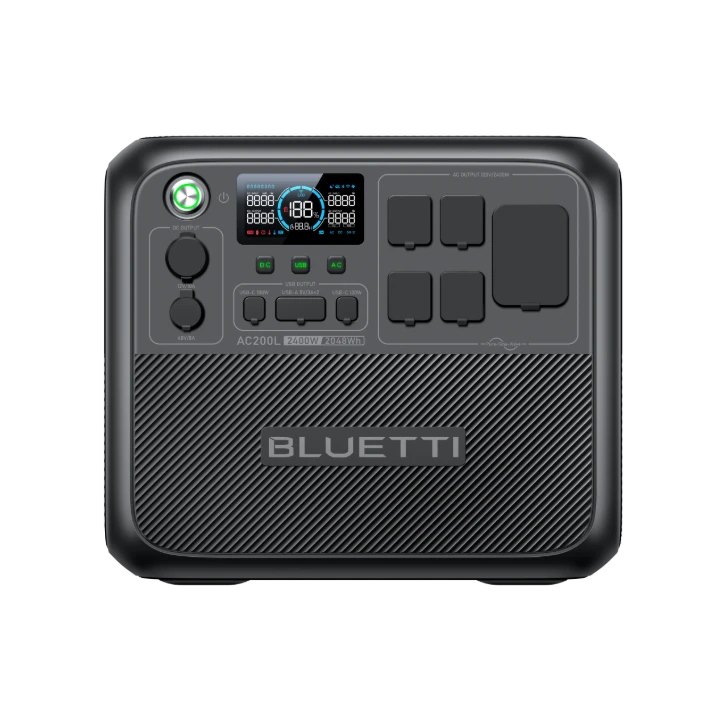
AC200L is the expandable ~2 kWh cabin pick: 2048 Wh and 2400 W now, with a claimed path to 8192 Wh (2×B300; also 2×B210 = 6348 Wh or 1×B230 = 4096 Wh). It is the only ~2 kWh box on the live generators hub that grows, and it has the highest solar-input ceiling on that hub: 1200 W, VOC 12–145 VDC, 15 A. Native MC4 panel path — BLUETTI 350W on the panels hub (that panel’s Voc is printed two ways, 33 V vs 46.5 V; cite both, do not pick one). TT-30 is still 120 V. Manufacturer: no 240 V split-phase. Power Lifting 3600 W. AC in 2400 W; claimed 0–80% in 45 minutes. LiFePO4. Cycle rating 3000+ cycles to 80% — do not paste Jackery 70%+ or EcoFlow 4000/80% onto this pack. UPS 20 ms (FAQ). Pass-through yes. Weight on the Specs table is 62.4 lb / 28.3 kg (a comparison table listed 61.6 lb; use Specs). U.S. manufacturer pages and the U.S. Amazon listing were live 25 Aug 2026; EU pages have said discontinued. (BLUETTI AC200L specs; solar-generator-ac200l specs)
Surge figures conflict on BLUETTI’s own pages. pages/ac200l lists 7200 W surge; the solar-generator-ac200l Specs table lists 4800 W. This hub cites both and does not pick one. If surge headroom matters for a motor start, confirm the current spec sheet.
Warranty (27 Aug 2026): BLUETTI Product Warranty Period table lists AC200L/AC200P L = 60 months. Product marketing says 5-year warranty. Same number; this hub uses the table. ~62 lb is cabin/garage, not a hike. Expansion batteries are proprietary BLUETTI (B210 / B230 / B300).
| Claim | Number | Source |
|---|---|---|
| Chemistry | LiFePO4 | Amazon listing + manufacturer pages |
| Capacity | 2048 Wh | pages/ac200l |
| AC output | 2400 W continuous (4×120 V/20 A + 1×120 V/30 A NEMA TT-30); Power Lifting 3600 W | same |
| Surge | 7200 W on pages/ac200l; 4800 W on solar-generator-ac200l Specs — conflicting manufacturer figures, both cited | pages/ac200l; solar-generator-ac200l |
| Solar input | 1200 W, VOC 12–145 VDC, 15 A | Manufacturer specs |
| AC in | 2400 W; claimed 0–80% in 45 min | same |
| Weight / size | 62.4 lb / 28.3 kg (Specs table); 16.5 × 11 × 14.4 in | Specs table (not the 61.6 lb comparison-table figure) |
| Ports | USB-C 2×100 W; USB-A 2×18 W; 48 V/8 A RV; 12 V/10 A car; plus AC including TT-30 | Manufacturer specs |
| Cycle rating | 3000+ cycles to 80% | same |
| UPS / transfer | 20 ms | Manufacturer FAQ |
| Expandable | 2×B210 = 6348 Wh / 1×B230 = 4096 Wh / 2×B300 = 8192 Wh (as claimed) | Manufacturer pages |
| Warranty | 60 months (AC200L/AC200P L row) | BLUETTI Product Warranty Period |
| Other | No 240 V split-phase; pass-through yes | Manufacturer pages |
Check price on Amazon · BLUETTI AC200L page
240 V workshop: EcoFlow DELTA Pro 3
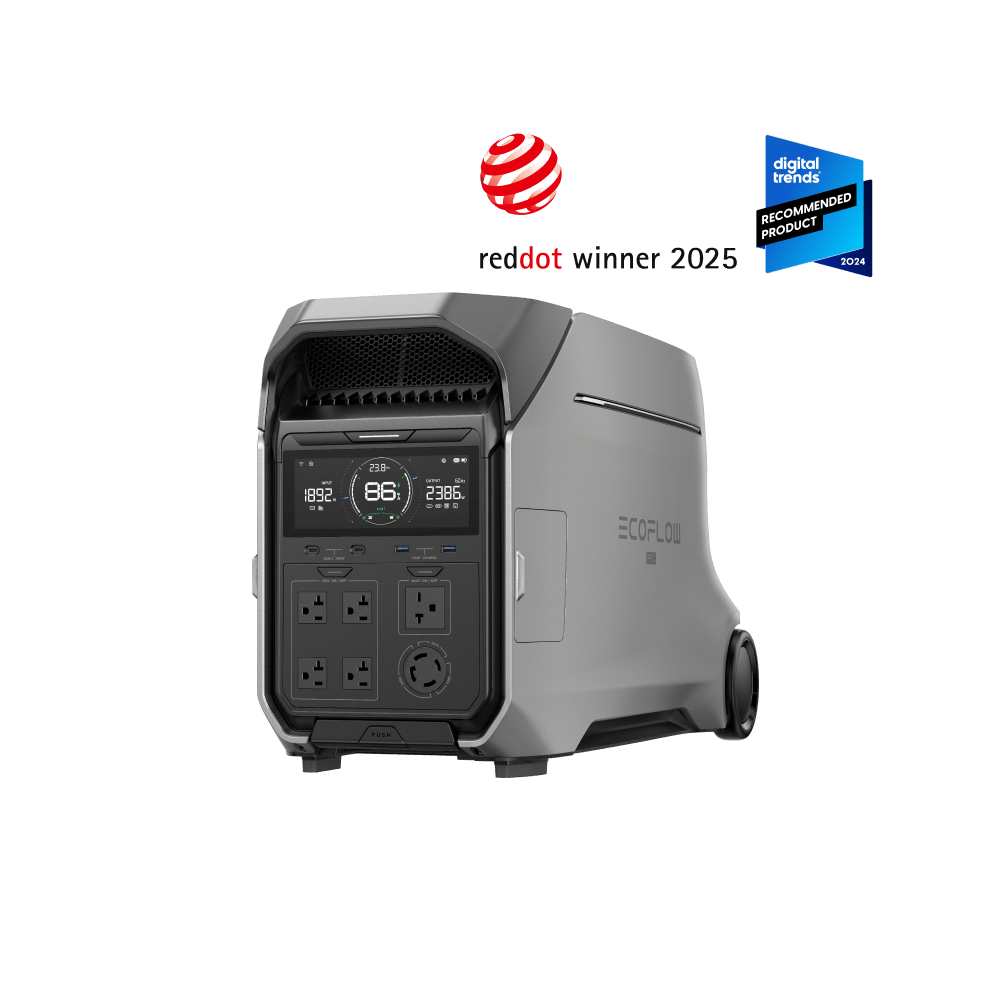
None of the six stations on the generators hub outputs 240 V split-phase. This is the new ASIN added for that job, verified as a live U.S. Amazon /dp/ on 27 August 2026 (HTML title, JSON asin B0D14FMFZD, marketplace ATVPDKIKX0DER, Add to Cart present). Native 120/240 V, 4000 W continuous, 4096 Wh LFP, with a NEMA L14-30R and 6-20R on the box. It is still a suitcase, not a hardwired house: EcoFlow copy for Smart Home Panel 2 / transfer switch requires a qualified electrician, and this hub does not sell that install as an Amazon how-to. (EcoFlow DELTA Pro 3 specs and FAQ)
120 V and 240 V are not simultaneous. EcoFlow’s FAQ: two AC buttons; pressing 120 V powers the 5-20R + TT-30 and turns 240 V off; pressing 240 V powers L14-30 + 6-20R and turns 120 V off. A 240 V compressor or well pump still has inrush this site has not measured.
AC: 4000 W continuous, 6000 W with X-Boost, surge 8000 W, 120/240 V ~ 16.7 A 60 Hz, 4000 W total. 120 V outlets: 4 × NEMA 5-20R 20 A + 1 × NEMA TT-30R 30 A. 240 V outlets: 1 × NEMA 6-20R 16.7 A; 1 × NEMA L14-30R 16.7 A (120/240 V). Solar: 2600 W total, 2 ports — High-PV 30–150 V, 15 A, 1600 W max; Low-PV 11–60 V, 20 A, 1000 W max. Cycle rating: 4000 cycles to 80% (Specs; FAQ restates 4000 cycles at a moderate charge/discharge rate of 0.5C/0.5C / 25 °C, over 80% SoH — state of health, how much capacity is left). UPS 10 ms. Weight 51.5 kg (113.54 lb); size 16.16 × 13.43 × 27.28 in. Battery pack IP65; main unit IP20 (FAQ: indoor or sheltered outdoor).
Expandable — do not collapse 12 / 36 / 48 kWh. Specs table: single unit 12 kWh (2 × DP3 Extra Battery). System* 36 kWh (6 × DP3 Extra Battery); up to 48 kWh**. Footnotes: *pair 3 inverters with Smart Home Panel 2; **requires 3 × DELTA Pro 3, 3 × extra batteries, 3 × Smart Generator 4000, 1 × Smart Home Panel 2 — sold separately. Extra-battery FAQ: DELTA Pro Smart Extra Battery is compatible with DELTA Pro 3 (firmware). DELTA Pro 3 Extra Battery is not compatible with original DELTA Pro. DELTA Pro 3 main unit is not compatible with DELTA Pro main unit or DELTA Pro Ultra.
Warranty conflict — cite both. U.S. Limited Warranty Policy table (updated 20 Oct 2025, fetched 27 Aug 2026): DELTA Pro 3 | 5 years. Product page hero: “Includes 3-year standard warranty and 2-year extended warranty available upon EcoFlow App registration.” Specs line: “5-year warranty.”
Stock split on 27 Aug 2026: EcoFlow US PDP said “This is a pre order item… DELTA Pro 3 ships in early September.” Amazon /dp/ had Add to Cart. Do not treat manufacturer preorder as Amazon out of stock, or vice versa. EcoFlow still prints a §25D educational disclaimer on this product page — do not copy it as a 2026 buyer benefit; see ITC.
| Claim | Number | Source |
|---|---|---|
| Chemistry | LFP | EcoFlow US Specs |
| Capacity | 4096 Wh | same |
| AC output | 4000 W continuous; 6000 W with X-Boost; surge 8000 W; 120/240 V ~ 16.7 A 60 Hz, 4000 W total | same |
| 120 V outlets | 4 × NEMA 5-20R 20 A + 1 × NEMA TT-30R 30 A | same |
| 240 V outlets | 1 × NEMA 6-20R 16.7 A; 1 × NEMA L14-30R 16.7 A (120/240 V) | same |
| Simultaneous 120 V + 240 V | No (two AC buttons; one bank on, the other off) | Manufacturer FAQ |
| Solar input | 2600 W total, 2 ports. High-PV 30–150 V, 15 A, 1600 W max. Low-PV 11–60 V, 20 A, 1000 W max | Specs |
| Cycle rating | 4000 cycles to 80% (FAQ: 4000 cycles at a moderate charge/discharge rate of 0.5C/0.5C / 25 °C, over 80% SoH — state of health, how much capacity is left) | Specs + FAQ |
| UPS / transfer | 10 ms | Specs |
| Weight / size | 51.5 kg (113.54 lb); 16.16 × 13.43 × 27.28 in | Specs |
| IP | Battery pack IP65; main unit IP20 (indoor or sheltered outdoor) | Specs + FAQ |
| Expandable | Single unit 12 kWh (2 × DP3 Extra Battery). System* 36 kWh; up to 48 kWh**. Footnotes on the Specs table — do not collapse 12 / 36 / 48 | Specs table footnotes |
| Warranty | Policy table 5 years; PDP also 3 + 2 upon app registration — conflicting manufacturer figures, both cited | US Limited Warranty Policy + product page |
Check price on Amazon · EcoFlow product page
240 V Amazon alt (not the pick): Anker SOLIX F3800 — live U.S. listing 27 Aug 2026. Manufacturer + user guide A1790: 3840 Wh, 6000 W, 120 V/240 V, NEMA 14-50 and L14-30, solar up to 2400 W (dual 1200 W), expandable to 53.8 kWh claimed, UPS 20 ms, net weight 60 kg / 132.2 lb, LiFePO4 in the user guide. Heavier than DELTA Pro 3; higher continuous watts on those 240 V ports. Brand-difference alt, not a second “best.” Check price on Amazon · Anker SOLIX F3800
Brand differences
Search traffic wants a logo winner. The useful differences are warranty channel, whether the pack can grow, which solar plug it takes, and whether 240 V exists on the suitcase. Extra batteries and native cables are brand-proprietary. A Jackery DC8020 panel will not magically become an EcoFlow extra battery.
Warranty (US, as printed — do not flatten 2+1 with 5)
| Brand / SKU in this hub | What the manufacturer actually prints | Source (opened 27 Aug 2026 unless noted) |
|---|---|---|
| EcoFlow DELTA 3 | 5 years | US warranty policy table, DELTA 3 Series row |
| EcoFlow RIVER 3 | 24 months | US warranty policy, RIVER Series |
| EcoFlow DELTA Pro 3 | Policy table 5 years; PDP also 3 + 2 upon app registration | Policy + PDP |
| Jackery Explorer 1000 v2 | Product 3+2; Service Policy 2+1 for 1000 Series; extra years “ONLY at Jackery.com” / official + authorized | Product PDP + Jackery Service Policy (updated 20 Aug 2026) |
| Jackery Explorer 2000 v2 | Product 3+2 / FAQ 3+2 for official / Jackery-branded / authorized dealers | Product PDP |
| Jackery Explorer 300 (not a pick) | Product 2+1 | Explorer 300 PDP |
| Jackery renewed | 6 months | Service Policy |
| BLUETTI AC200L | 60 months | BLUETTI Product Warranty Period |
| Anker SOLIX C1000 Gen 2 | Registration page: registering “Activates 5-year hassle-free protection” for Anker SOLIX portable power stations; C1000 Gen 2 is on the product list | Warranty registration |
| Anker SOLIX F3800 | Same registration list (5-year portable-station sentence) | Same page |
Jackery extra years are channel-dependent. EcoFlow DELTA Pro 3 3+2 vs 5-year table is a manufacturer conflict — both are published above. Amazon buyers may not get Jackery’s extra years.
Expandability
| Brand | On-site / this-hub SKUs | Grows? |
|---|---|---|
| Jackery | 1000 v2, 2000 v2 | No. Plus / HomePower lines are the expandable Jackery path — not verified as Amazon picks in this page, so no ASINs here. |
| EcoFlow | DELTA 3 | Yes, claimed to 5 kWh with listed EcoFlow extras (DELTA 3 / Plus / Pro 3 / DELTA 2 / DELTA 2 Max extras — as on the DELTA 3 PDP, 25 Aug). |
| EcoFlow | RIVER 3 | No |
| EcoFlow | DELTA Pro 3 | Yes, 12 kWh single-unit / 36–48 kWh system footnotes (do not collapse) |
| BLUETTI | AC200L | Yes, B210 / B230 / B300 as claimed (max 8192 Wh with 2×B300) |
| Anker | C1000 Gen 2 | No (mfr comparison table). Do not copy the PDP’s “C1000 + Expansion Battery” bundle (no “Gen 2” in that option name) onto Gen 2. |
| Anker | F3800 | Yes, claimed to 53.8 kWh (mfr F3800 page) |
Solar input + connectors
Industry MC4 ≠ Jackery DC8020 ≠ EcoFlow XT60i. An adapter is a separate SKU unless the panel box list names it. Full pairing tables: Best Portable Solar Panels for Power Stations (2026).
| Station | Solar max | Window (as documented) | Native panel connector |
|---|---|---|---|
| Jackery 1000 v2 | 400 W | Dual DC 8 mm, 16–60 V, dual 21 A | DC8020 / DC7909 — SolarSaga 200W on the panels hub |
| Jackery 2000 v2 | 400 W | Dual DC 8 mm; 11–16 V and 16–60 V, 400 W / 21 A (Tech Specs 27 Aug 2026) | Same Jackery DC 8 mm |
| EcoFlow DELTA 3 | 500 W | DC 11–60 V | XT60 / XT60i — NextGen 220W on the panels hub |
| EcoFlow RIVER 3 | 110 W | Watts only; do not copy 11–30 V car input as solar Voc | XT60 family; none of the five verified foldables on the panels hub is sized to 110 W |
| EcoFlow DELTA Pro 3 | 2600 W total | High 30–150 V / 15 A / 1600 W; Low 11–60 V / 20 A / 1000 W | EcoFlow PV family (high + low ports) |
| Anker C1000 Gen 2 | 600 W | Split MPPT 11–28 V 8.2 A and 29–60 V 14.5 A | PS400 on the panels hub uses the high window (Vmp 48 V). A ~18 V 200 W panel lands in the 8.2 A slice and can clip. |
| BLUETTI AC200L | 1200 W | VOC 12–145 VDC, 15 A | MC4 — BLUETTI 350W on the panels hub (Voc conflict 33 V vs 46.5 V — cite both) |
| Anker F3800 | 2400 W (2 × 1200 W) | User guide: two solar inputs, firmware-dependent amp windows, 60 V class | MC4 / Anker solar leads |
A 400 W-max Jackery will clip a 600 W array. Panel STC watts are not field output. Match Voc and current to the printed window; in cold sun, Voc rises.
240 V
| Brand | Verified SKU in this page | 240 V on one box? |
|---|---|---|
| Jackery | 1000 v2, 2000 v2 | No (120 V) |
| EcoFlow | DELTA 3, RIVER 3 | No |
| EcoFlow | DELTA Pro 3 | Yes — L14-30 + 6-20R. Not simultaneous with 120 V outlets. |
| BLUETTI | AC200L | No split-phase (mfr). TT-30 is 120 V. |
| Anker | C1000 Gen 2 | No (120 V) |
| Anker | F3800 | Yes — NEMA 14-50 and L14-30, 6000 W max on those ports (user guide). |
A 120 V camping station is the wrong tool for a 240 V well pump. Split-phase / hybrid-inverter / transfer-switch work is an electrician job, not this Amazon suitcase. Amazon CTAs on this page stay on the portable station.
Quiet (manufacturer dB only — this site has not metered)
- Jackery 1000 v2: 30 dB (PDP)
- Jackery 2000 v2: <30 dB quiet mode, 45 dB full load at 1 m (PDP Data Note)
- EcoFlow DELTA Pro 3: “as low as 30 dB” X-Quiet (marketing; asterisk on PDP)
All four brands’ lithium stations are the indoor-safe contrast to a gas generator (no exhaust). That is the quiet-camping vs motor point — not a lab ranking of fan noise among the four logos. Anker C1000 Gen 2 has no dB figure in the research used for this page; this hub does not invent one.
LiFePO4 cycle ratings are not interchangeable
Do not copy “4000 cycles to 80%” onto a Jackery. Jackery’s 70%+ end-of-test is not the same claim as EcoFlow/Anker 80%.
| SKU | Published cycle line |
|---|---|
| EcoFlow DELTA 3 | 4000 cycles to 80+% |
| EcoFlow DELTA Pro 3 | 4000 cycles to 80% |
| Anker C1000 Gen 2 | 4,000 cycles to ≥80% |
| Jackery 1000 v2 / 2000 v2 | 4000 cycles to 70%+ |
| EcoFlow RIVER 3 | 3000 cycles to 80% |
| BLUETTI AC200L | 3000+ cycles to 80% |
Anker C1000 Gen 2 chemistry: Amazon title LiFePO4; fetched manufacturer spec tables (25 Aug 2026) did not print the word LiFePO4 — same caveat as the generators hub.
Remaining NMC Jackery SKUs — no product card
Jackery’s own chemistry table (updated 19 Aug 2026) still lists Explorer 300, 500, and 880 as NMC and “Available on the official website and authorized third-party sellers.” Current v2 / Plus / HomePower rows on that table are LiFePO4. The live Amazon Explorer 300 title on 27 Aug 2026 had been rewritten as LiFePO4; that listing is a listing/manufacturer conflict with Jackery’s NMC table and with the jackery.com Explorer 300 PDP (lithium-ion, 800 cycles to 80%). This hub does not treat that Amazon title as a verified remaining-NMC SKU, and does not recommend it as LFP either. Buy v2 / Plus / HomePower if you want the chemistry Jackery prints as LFP on the current PDPs (1000 v2 / 2000 v2 in this hub). Independent LFP vs NMC cell cycling: Preger et al., J. Electrochem. Soc. (Sandia) — do not invent “LFP lasts 10× NMC.” (Jackery chemistry table; Preger et al.)
No 30% ITC on 2026 portables
The IRS Residential Clean Energy Credit “equals 30% of the costs of new, qualified clean energy property for your home installed anytime from 2022 through December 31, 2025.” The credit is not available for any property placed in service after December 31, 2025. Battery storage (when the credit applied) had to be at least 3 kilowatt hours. Used property is not eligible. The credit is claimed for the year the property is installed, not merely purchased. (IRS Residential Clean Energy Credit, opened 27 Aug 2026)
EnergySage (updated 23 Mar 2026): §25D expired for customer-owned systems; unused 2025 credit can still carry forward; leases/PPAs may still use commercial §48E. (EnergySage)
A 2026 Jackery / EcoFlow / BLUETTI / Anker portable bought and placed in service in 2026 does not get 30% off. Even before expiry, 245 Wh and ~1 kWh stations were under 3 kWh. DELTA Pro 3 is ≥3 kWh on paper and EcoFlow still prints a §25D educational blurb — this hub does not turn that into a 2026 Amazon CTA. Family Handyman-style “eligible for 30% IRA” copy on DELTA Pro 3 is stale.
Practical notes
Certified-refurb vs marketplace used
EcoFlow’s own refurbished guide (dated 2025/9/23, opened 27 Aug 2026) distinguishes a manufacturer refurb (returns/demos that go through a test-and-repair line, including a battery-health / cycle-count check, sometimes a replaced pack) from “something used from another person.” EcoFlow’s own table says a good refurb warranty is often shorter than new (their example: new 2–5 years vs refurbished 90 days to 1 year). Jackery’s Service Policy (updated 20 Aug 2026) is more specific on Jackery’s own channel: “A 6 month warranty on renewed Jackery products,” and Jackery’s limited warranty does not apply to any product purchased through an online auction house. Prefer a brand-renewed / manufacturer-refurb listing with a printed warranty over a third-party Marketplace “used” offer with no battery-cycle report. This site has not inspected refurb QC. (EcoFlow refurbished guide; Jackery Service Policy)
How to pick among these four logos
- Carryable quiet camp kit, native SolarSaga cable: Explorer 1000 v2. Need more inverter watts in the same ~1 kWh class, and you accept no expansion: C1000 Gen 2.
- One typical older-fridge day in a lighter ~2 kWh box: Explorer 2000 v2. Same energy class but you want to add BLUETTI extra batteries and 1200 W of solar later: AC200L.
- A 240 V outlet on the suitcase (welder / dryer / well-pump class): DELTA Pro 3, knowing 120 V and 240 V are mode-switched, ~114 lb, and a transfer switch is an electrician. F3800 is the heavier 240 V Amazon alt, not a second pick.
- Whole-home from a 1 kWh camping brick: no. The generators hub already forbids that, and so does this page.
Size the job in watt-hours first: How Much Solar Generator Do I Need? Then match the panel plug: Best Portable Solar Panels for Power Stations (2026).
Specs and Amazon.com listings checked August 25, 2026 (Jackery 1000 v2, Jackery 2000 v2, BLUETTI AC200L, Anker C1000 Gen 2) and August 27, 2026 (EcoFlow DELTA Pro 3, Anker F3800; Jackery 2000 v2 solar window and warranty pages re-opened). This page does not include prices. Confirm the live listing and the current manufacturer spec table before you buy.
How we sourced this
This is a spec hub, not a hands-on review. We have not lab-tested or lived with these units, metered fan noise, or timed a fridge compressor. Capacities, outputs, solar limits, weights, warranties, and cycle claims below come from manufacturer spec pages (and, where the maker’s table is silent, from the live Amazon.com title). Amazon.com listings for Jackery Explorer 1000 v2, Explorer 2000 v2, BLUETTI AC200L, and Anker SOLIX C1000 Gen 2 were checked as live U.S. product pages on August 25, 2026. EcoFlow DELTA Pro 3 and Anker SOLIX F3800 were checked August 27, 2026. Jackery 2000 v2 solar voltage, Jackery / EcoFlow / BLUETTI warranty pages, and the DELTA Pro 3 spec table were re-opened August 27, 2026. Re-open any listing before you buy — stock and titles change. No prices on this page.
Disclosure: As an Amazon Associate I earn from qualifying purchases. Some links are affiliate links. You pay the same.