Disclosure: As an Amazon Associate I earn from qualifying purchases. I also earn a commission from some other retailers, including Anker SOLIX, BLUETTI, and EcoFlow (through CJ). You pay the same.
Short on time? Most readers here pick by job. Here are the two picks that cover the most jobs:
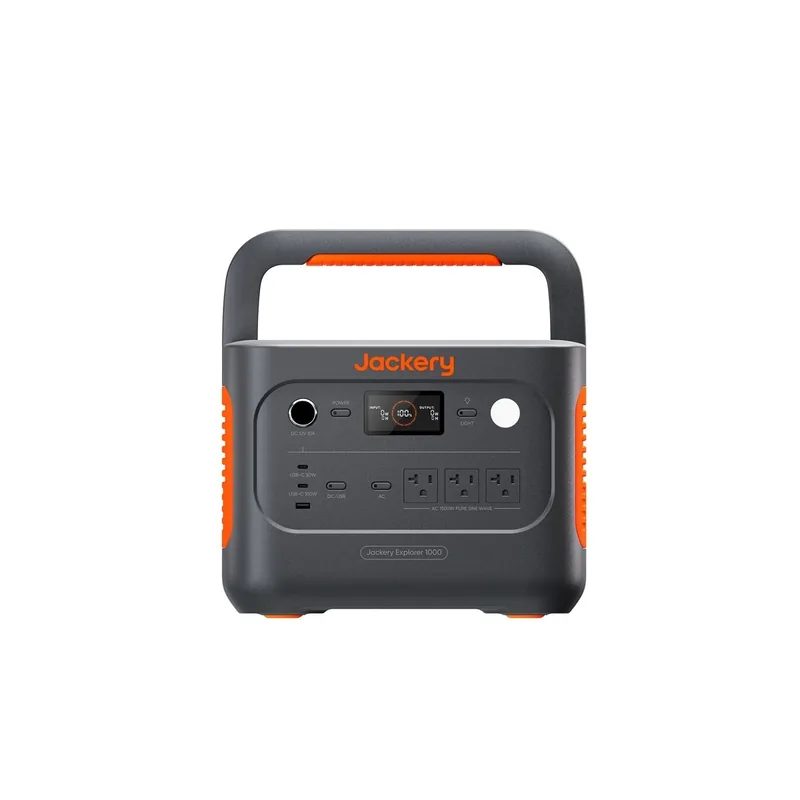
~1 kWh, carryable: Jackery Explorer 1000 v2 (1024 Wh, 1500 W, 23.8 lb).
Sold out now: see in-stock 1 kWh picks
~2 kWh, most solar in: BLUETTI Elite 200 V2 (2073.6 Wh, 2600 W, up to 1000 W solar).
Check price at BLUETTI
| Job | Pick | Capacity | AC continuous | Solar max | Weight | Buy |
|---|---|---|---|---|---|---|
| Quiet camping | Jackery Explorer 1000 v2 | 1024 Wh | 1500 W | 400 W | 23.8 lb | Sold out now: see in-stock 1 kWh picks |
| Fridge overnight | Jackery Explorer 2000 v2 | 2042 Wh | 2200 W | 400 W | 39.5 lb | Amazon |
| Cabin, most solar in | BLUETTI Elite 200 V2 | 2073.6 Wh | 2600 W | 1000 W | 44.5 lb | BLUETTI |
| Compact high output | Anker SOLIX C1000 Gen 2 | 1,024 Wh | 2,000 W | 600 W | 24.9 lb | Amazon · Anker |
| 240 V workshop | EcoFlow DELTA Pro 3 | 4096 Wh | 4000 W | 2600 W total | 113.54 lb | Check price at EcoFlow |
Quick answer: tell us the job, here’s the box.
Need quiet camping power (phones, lights, laptop, small camp fridge) → Jackery Explorer 1000 v2. Sold out now: see in-stock 1 kWh picks
Need a full-size fridge overnight → Jackery Explorer 2000 v2. Check price on Amazon
Need a cabin box with room for panels (up to 1000 W of solar in, not expandable) → BLUETTI Elite 200 V2. Check price at BLUETTI
Need 240 V for the workshop → EcoFlow DELTA Pro 3. Check price at EcoFlow
Need more inverter headroom in a ~1 kWh box (2000 W, 24.9 lb, not expandable) → Anker SOLIX C1000 Gen 2. Check price on Amazon
No brand wins everything. Each one just wins a different job. Manufacturer specs, not hands-on tests; details below.
This is a brand × use-case page, not a second “best solar generators 2026” spreadsheet. Four jobs, one suitcase per job, plus the compact high-output Anker already on the generators hub. For the six-station capacity / output / weight table, see Best Solar Generators / Portable Power Stations (2026). For watt-hours vs watts and fridge math, see How Much Solar Generator Do I Need? For Voc, connectors, and first-choice foldables, see Best Portable Solar Panels for Power Stations (2026).
Jackery, EcoFlow, BLUETTI, and Anker do not make interchangeable boxes. Warranties are channel-dependent. Extra batteries are brand-proprietary. Jackery DC8020 is not EcoFlow XT60i is not industry MC4. Cycle ratings to 70%+ are not the same claim as 80%. Where two manufacturer pages disagree, this hub cites both and does not pick a winner. A 2026 portable bought and placed in service in 2026 does not get a 30% Residential Clean Energy Credit — see the ITC note below.
- Use-case matrix
- Quick comparison
- Quiet camping: Jackery Explorer 1000 v2
- Compact high output (not expandable): Anker SOLIX C1000 Gen 2
- Fridge overnight: Jackery Explorer 2000 v2
- Most solar in a ~2 kWh box: BLUETTI Elite 200 V2
- 240 V workshop: EcoFlow DELTA Pro 3
- Brand differences (warranty, expandability, solar, 240 V, quiet)
- LiFePO4 cycles and leftover NMC SKUs
- No 30% ITC on 2026 portables
- Practical notes (refurb, panels, electrician jobs)
Each brand runs its own holiday sale on its own dates. See Black Friday portable power station deals: when to buy for last year’s timing by brand.
Use-case matrix
Arithmetic uses named kWh/day figures already on How Much Solar Generator Do I Need? — a DOE FEMP ENERGY STAR fridge example of ≈ 1.0 kWh/day, and an ORNL representative 1.5–2.0 kWh/day. This site has not timed a compressor. Inverter losses and surge are not included. Numbers in the product sections are manufacturer claims unless noted.
Not sure which row is yours? Run your devices through our portable power station size calculator, then match the result to the table below.
| Job | Capacity you actually need | Pick | Will not do |
|---|---|---|---|
| Quiet camping (phones, lights, laptop, small camp fridge — not a household fridge) | ~1 kWh / 1500 W class; carryable | Jackery Explorer 1000 v2 | Multi-day house fridge; 240 V tools |
| Fridge overnight (full-size household fridge, maybe router + LEDs) | ~2 kWh class | Jackery Explorer 2000 v2 | 48-hour fridge+HVAC; 240 V well pump |
| Home / weekend cabin with room for panels (fast refill from solar) | ~2 kWh, up to 1000 W of solar in | BLUETTI Elite 200 V2 | Add-on batteries (not expandable); 240 V; TT-30 RV hookup; grab-and-go at 44.5 lb |
| 240 V workshop (welder, dryer, well-pump class — still not a hardwired house) | 4 kWh+ and a 240 V outlet on the box | EcoFlow DELTA Pro 3 | Simultaneous 120 V + 240 V on this SKU (EcoFlow FAQ: no). Transfer-switch install is an electrician job. |
This page compares four station brands. If you want a DIY plan you download and build, see Energy Revolution System plans.
Camping alt (not the pick): Anker SOLIX C1000 Gen 2 — 24.9 lb, 2000 W, 600 W solar, not expandable. Use if inverter headroom matters more than Jackery’s native SolarSaga cable. Full spec card below; it is already the compact high-output slot on the generators hub.
Expandable alt at ~1 kWh (not the pick): EcoFlow DELTA 3 — claimed expansion to 5 kWh, but the base pack is still one efficient-fridge-day. Specs live on the generators hub.
Ultralight day-trip (not a camping-fridge pick): EcoFlow RIVER 3 — 245 Wh / 300 W / 7.8 lb. Will not run a household fridge or an all-night humidifier CPAP. The Amazon title still garbles capacity as “245W”; use the manufacturer 245 Wh. Specs on the generators hub.
Quick comparison
The four job picks plus the compact high-output Anker. Prices change daily, so tap through for today’s number. None of these is a whole-house hardwired system.
| Job | Model | Capacity | AC continuous | Solar max | Weight | Expandable? | 240 V on the box? |
|---|---|---|---|---|---|---|---|
| Quiet camping | Jackery Explorer 1000 v2 | 1024 Wh | 1500 W | 400 W | 23.8 lb | No | No (120 V) |
| Compact high output (not the camping pick) | Anker SOLIX C1000 Gen 2 | 1,024 Wh | 2,000 W | 600 W | 24.9 lb | No | No (120 V) |
| Fridge overnight | Jackery Explorer 2000 v2 | 2042 Wh | 2200 W | 400 W | 39.5 lb | No | No (120 V) |
| Most solar in, ~2 kWh | BLUETTI Elite 200 V2 | 2073.6 Wh | 2600 W | 1000 W | 44.5 lb | No | No (120 V) |
| 240 V workshop | EcoFlow DELTA Pro 3 | 4096 Wh | 4000 W | 2600 W total | 113.54 lb | Yes (12 kWh single-unit / 36–48 kWh system footnotes — do not collapse) | Yes — L14-30 + 6-20R; not simultaneous with 120 V |
Sources: Jackery Explorer 1000 v2, Anker SOLIX C1000 Gen 2, Jackery Explorer 2000 v2, BLUETTI Elite 200 V2, EcoFlow DELTA Pro 3. Jackery, BLUETTI and EcoFlow all say LFP (LiFePO4) on their own sites. Anker’s site doesn’t name the chemistry, though the Amazon listing says LiFePO4 and Anker rates it for 4,000 cycles. Cycle ratings also stop at different percentages by brand (see cycles).
Quiet camping: Jackery Explorer 1000 v2
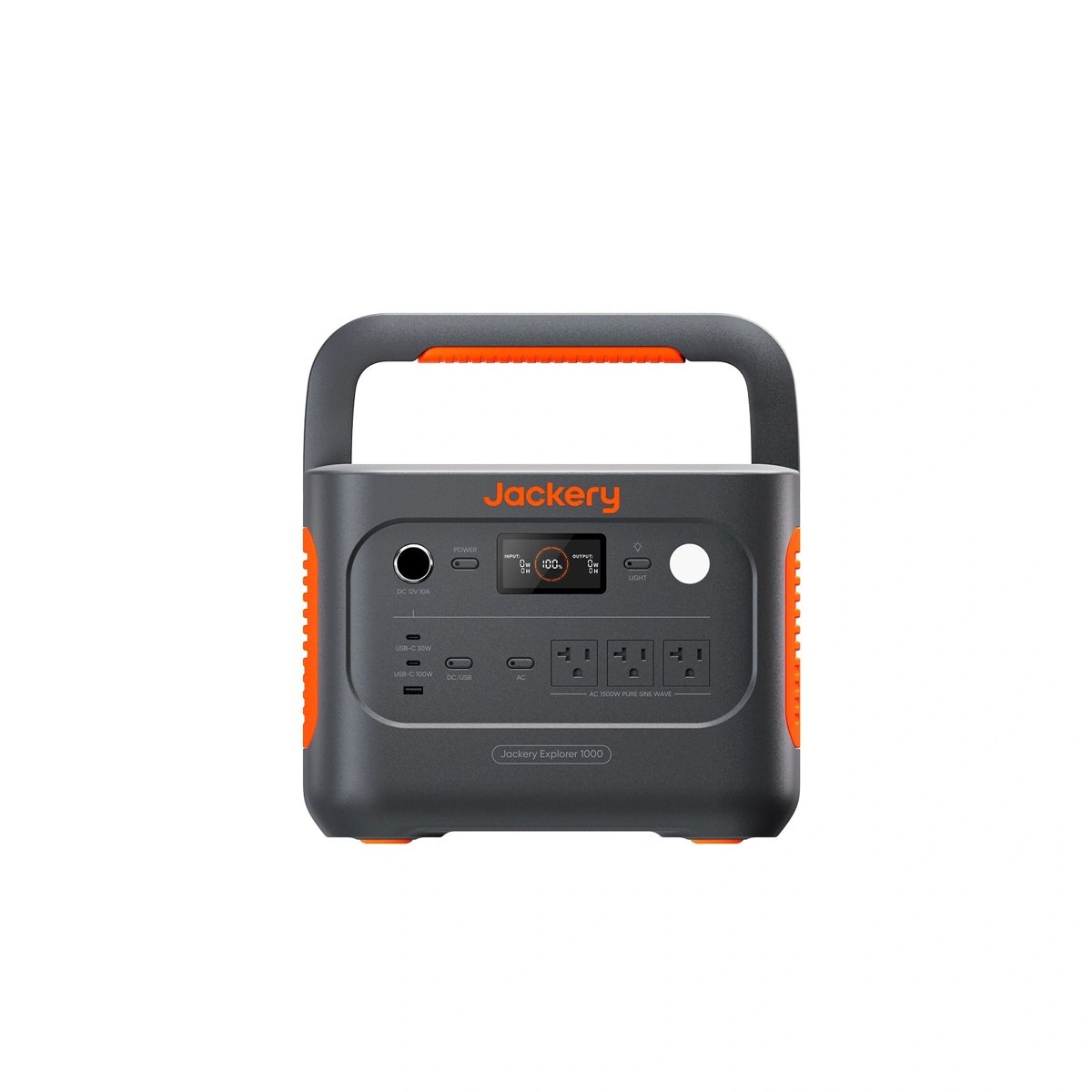
Photo: Jackery
For a carryable ~1 kWh camp box (phones, lights, a laptop, a small camp fridge, but not a household fridge), Explorer 1000 v2 is the pick because it’s the lightest ~1 kWh station here at about 23.8 lb, with a native Jackery SolarSaga DC8020 / DC7909 path. Jackery’s product copy calls it the “World’s smallest and lightest 1kWh LFP” and “At 30 dB, it’s as quiet as a whisper.” That’s Jackery talking; we haven’t put a meter on the fan. Specs: 1024 Wh, 1500 W continuous / 3000 W surge, LiFePO4, solar 400 W max (dual DC 8 mm, 16–60 V, dual to 21 A), cycle rating 4000 cycles to 70%+ (not 80%), UPS ≤20 ms, not expandable. Pair with Jackery SolarSaga 200W from the portable panels hub. (Jackery Explorer 1000 v2 tech specs)
Warranty conflict — cite both, do not tell Amazon shoppers they automatically get five years. Product Tech Specs and FAQ (re-opened 27 Aug 2026): 3+2 years. FAQ: “3 years standard warranty and 2 years extended warranty… only… official Jackery website, Jackery-branded third-party platforms, or local authorized dealers.” Hero copy: “3-Year Warranty + 2 Extra Years Free — Exclusively at jackery.com.” Jackery Service Policy (updated 20 Aug 2026): 2+1 years for “1500 Series/1000 Series/500 Series/300 Series/240 Series/160 Series.” Extra years are channel-dependent.
Caveat: lower AC and solar headroom than C1000 Gen 2 (2000 W / 600 W) or DELTA 3 (1800 W / 500 W, expandable). 1500 W / 120 V will not run a 240 V tool. Do not copy EcoFlow/Anker “to 80%” wording onto this pack.
| Claim | Number | Source |
|---|---|---|
| Chemistry | LiFePO4 | Jackery tech specs |
| Capacity | 1024 Wh (20 Ah / 51.2 V) | same |
| AC output | 1500 W continuous / surge 3000 W | same |
| Solar input | Dual DC 8 mm, 400 W max, 16–60 V working voltage, dual to 21 A | same |
| Weight / size | ~23.8 lb / 10.8 kg; 12.87 × 8.82 × 9.72 in | same |
| Ports | USB-C 30 W + 100 W, USB-A 18 W, car 12 V/10 A, plus AC | same |
| Quiet (mfr copy, not metered here) | 30 dB | Product page |
| Cycle rating | 4000 cycles to 70%+ (not 80%) | Tech specs |
| UPS / transfer | ≤20 ms | same |
| Expandable | No | same |
| Warranty | Product 3+2 (extra years official / Jackery-branded / authorized, “exclusively at jackery.com”); Service Policy 2+1 for 1000 Series — conflicting manufacturer figures, both cited | Product page + Jackery Service Policy |
Sold out now: see in-stock 1 kWh picks · Jackery product page
Compact high output (not expandable): Anker SOLIX C1000 Gen 2
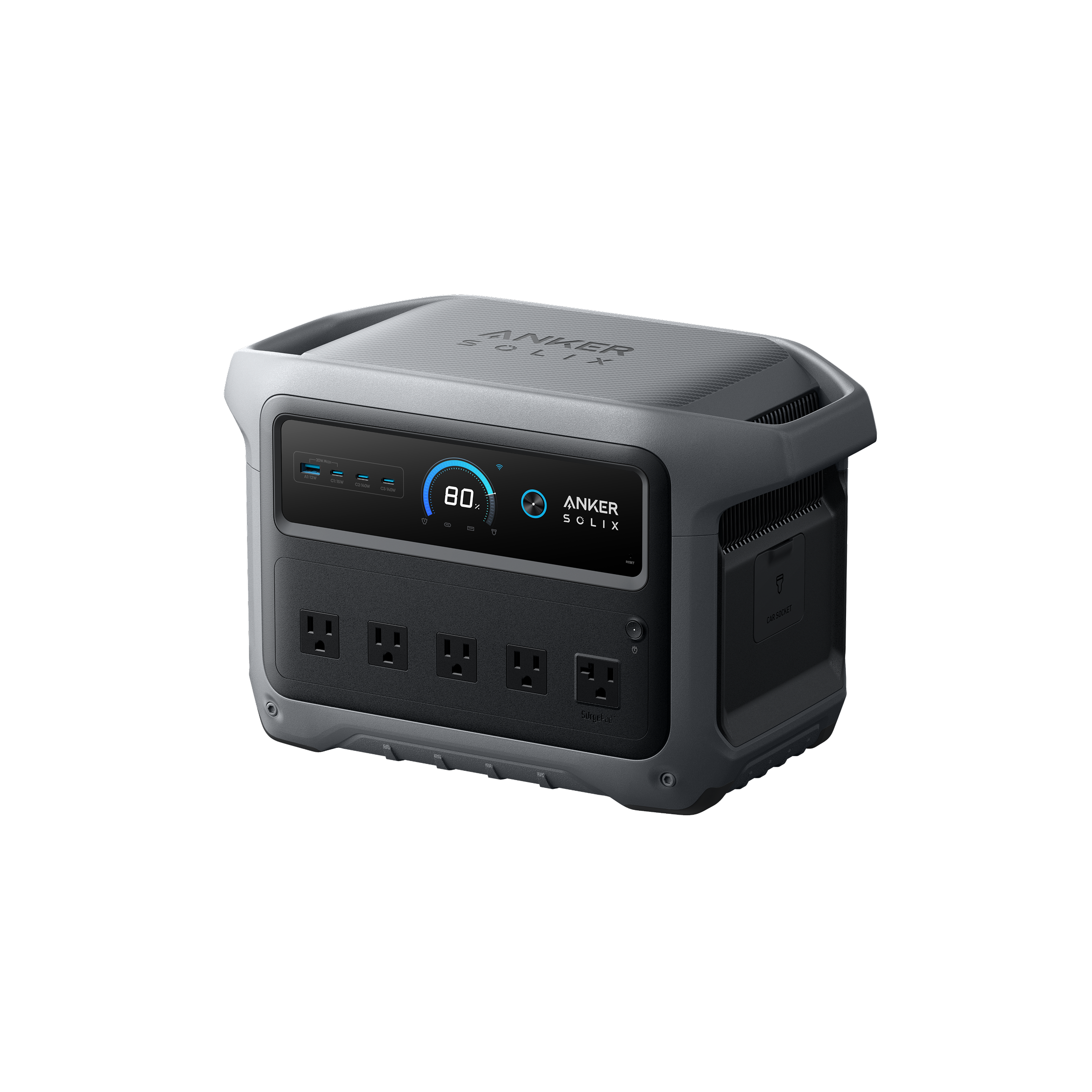
Photo: Anker
This is not the quiet-camping pick. It is the compact high-output ~1 kWh box already on the generators hub: model A1763, 1,024 Wh, 2,000 W continuous AC, and the highest solar-input ceiling in this size class at 600 W max, at 24.9 lb. Use it when inverter headroom (and the 600 W MPPT) matter more than Jackery’s native DC8020 cable. Anker claims a full charge in 49 minutes via 1,600 W UltraFast AC (1,200 W is the standard AC-charge figure). UPS transfer is listed at 10 ms. (Anker SOLIX C1000 Gen 2; A1763 user guide)
Don’t mix up the two surge numbers. Anker advertises a 3,000 W peak, but the user guide lists SurgePad up to 2,400 W. If you’re starting a saw or a compressor, plan around the lower one.
Chemistry: the Amazon listing says LiFePO4, and Anker rates it for 4,000 cycles to ≥80%, which fits LFP. Anker’s own site just doesn’t spell the chemistry out.
It is not expandable. Anker says the Gen 2 doesn’t take an add-on battery (the original C1000 does). You may spot a “C1000 + Expansion Battery” bundle on Anker’s page; that’s for the older model, not the Gen 2. So ~1 kWh is a hard ceiling, and it is short for multi-day home backup.
Solar window is split MPPT: 11–28 V 8.2 A and 29–60 V 14.5 A (600 W max). Anker SOLIX PS400 (first-choice panel on the panels hub) uses the high window (Vmp 48 V). A ~18 V 200 W panel lands in the 8.2 A slice and can clip. See Best Portable Solar Panels.
| Claim | Number | Source |
|---|---|---|
| Chemistry | LiFePO4 on the Amazon listing; Anker’s site doesn’t say | Amazon listing; cycle rating from Anker product page |
| Capacity | 1,024 Wh | Anker product page |
| AC output | 2,000 W continuous, 3,000 W peak | Amazon listing + product page |
| SurgePad | Up to 2,400 W (not the same number as the 3,000 W peak) | A1763 user guide |
| Solar input | 600 W max. Live specs: MPPT 11–28 V 8.2 A; 29–60 V 14.5 A (600 W max) | Product-page specs table |
| AC charge | 1,200 W standard / 1,600 W UltraFast; claimed full charge in 49 min | Product page |
| Weight / size | 24.9 lb / 11.3 kg; 15.12 × 8.19 × 9.61 in | Product page |
| Ports | USB-C2/C3 140 W, USB-C1 15 W, USB-A 12 W (A+C1 total 20 W), car 12 V/10 A/120 W, plus AC | Product page / user guide |
| Cycle rating | 4,000 cycles to ≥80% | Product page |
| UPS / transfer | 10 ms | Product page |
| Expandable | No (manufacturer comparison table) | Product page |
| Warranty | Registration page: registering “Activates 5-year hassle-free protection” for Anker SOLIX portable power stations; C1000 Gen 2 is on the product list | Anker SOLIX warranty registration |
Check price on Amazon · Check price at Anker
Fridge overnight: Jackery Explorer 2000 v2
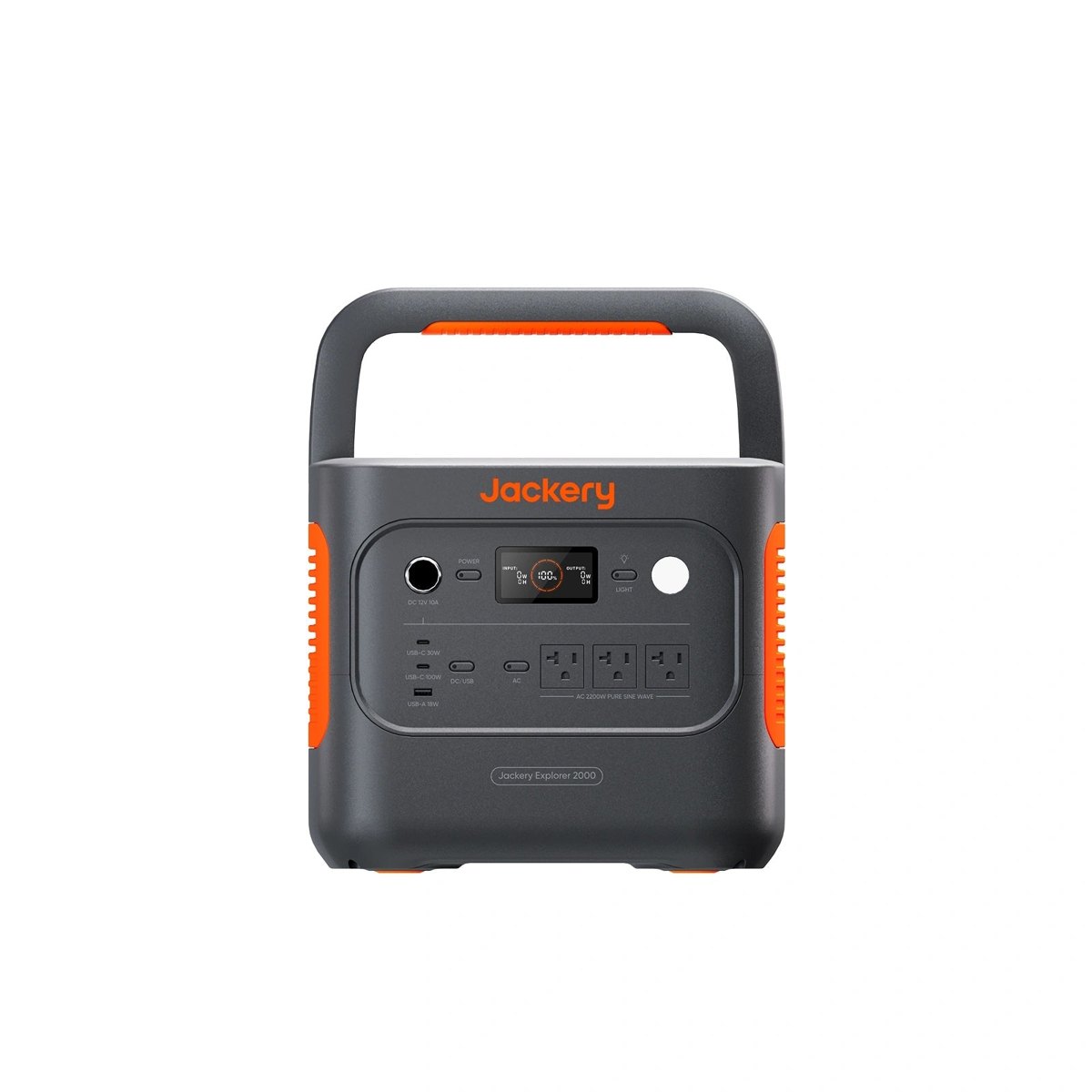
Photo: Jackery
For a full-size household fridge overnight (maybe a router and LEDs), Explorer 2000 v2 is the pick because 2042 Wh is the lighter of the two ~2 kWh boxes here (39.5 lb vs Elite 200 V2 44.5 lb). Rough math: ~2 kWh covers about one typical older-fridge day (ORNL puts those at 1.5–2.0 kWh/day). It isn’t a 48-hour kit, and that math leaves out inverter loss and compressor surge. AC is 2200 W continuous / 4400 W surge. Jackery rates it at <30 dB in quiet mode and 45 dB at full load, measured at 1 m. We haven’t metered it ourselves. LiFePO4. Cycle rating 4000 cycles to 70%+. UPS <20 ms. Jackery’s FAQ says it’s not expandable. If you want to add batteries later, Jackery points you to the Solar Generator 2000 Plus instead. (Jackery Explorer 2000 v2 tech specs and FAQ)
Solar voltage is not a copy of 1000 v2. Jackery Tech Specs re-opened 27 Aug 2026 now print the 2000 v2 window (the generators-hub pull had it unpublished). Dual DC 8 mm, 400 W max. Working voltage: 11–16 V 8 A (double to 8 A) and 16–60 V 12 A (double to 21 A / 400 W). Same 400 W ceiling as 1000 v2 — more battery, not more solar headroom. First-choice panel remains SolarSaga 200W, one or two, from the panels hub.
Warranty: Jackery lists 3+2 years for units bought from Jackery or an authorized dealer. Ignore the “1000 Series” 2+1 line in Jackery’s service policy, because it doesn’t cover the 2000 v2. The extra two years are a jackery.com perk, so don’t count on five years if you buy on Amazon.
Stock on this one flips often, and some bundles show Sold Out while the bare unit is available, so check Amazon or Jackery before you buy. Still 120 V only. 400 W solar is modest for 2 kWh. Not a well-pump box.
| Claim | Number | Source |
|---|---|---|
| Chemistry | LiFePO4 | Jackery tech specs |
| Capacity | 2042 Wh | same |
| AC output | 2200 W continuous / surge 4400 W | same |
| Solar input | Dual DC 8 mm, 400 W max. Working voltage: 11–16 V 8 A (double to 8 A) and 16–60 V 12 A (double to 21 A / 400 W) | Tech Specs re-opened 27 Aug 2026 — do not copy 1000 v2’s 16–60 V-only line onto this SKU |
| Weight / size | ~39.5 lb / 17.9 kg; 13.2 × 10.4 × 11.5 in | Tech specs |
| Ports | USB-C 30 W + 100 W; USB-A 18 W; car 12 V/10 A; plus AC | same |
| Quiet (mfr Data Note, not metered here) | <30 dB quiet mode; 45 dB full load at 1 m | Jackery data note |
| Cycle rating | 4000 cycles to 70%+ | Tech specs |
| UPS / transfer | <20 ms | same |
| Expandable | No | Manufacturer FAQ |
| Warranty | Product 3+2 / FAQ 3+2 for official / Jackery-branded / authorized. Policy “1000 Series” 2+1 language does not name 2000 v2 — so don’t count on that extra year for the 2000 v2. | Product page |
Check price on Amazon · Jackery product page
Most solar in a ~2 kWh box: BLUETTI Elite 200 V2
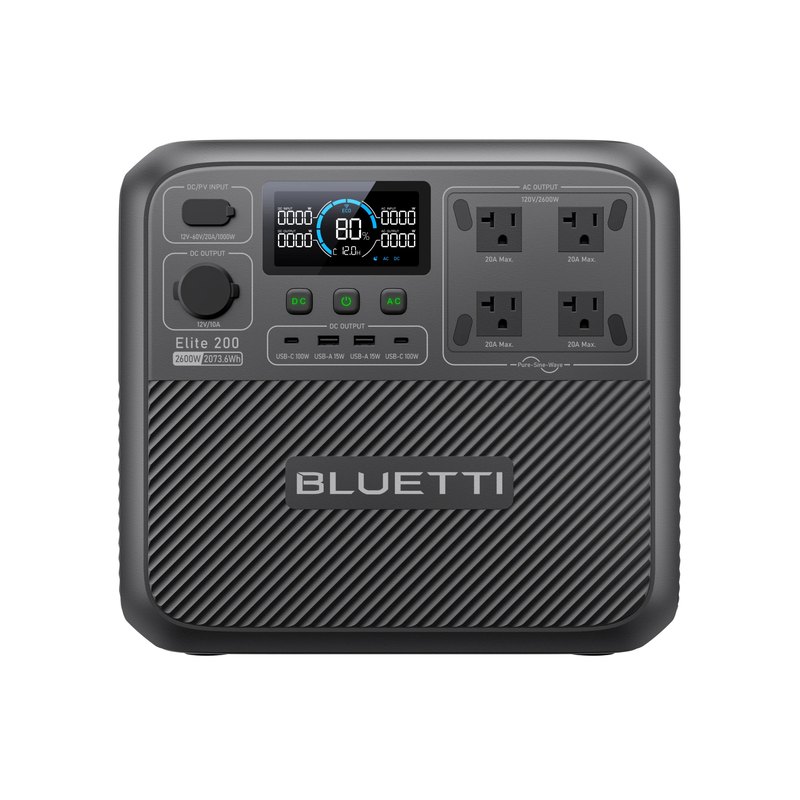
Photo: BLUETTI
Elite 200 V2 is the BLUETTI pick: 2073.6 Wh and 2600 W continuous, 120 V. Its reason to be here is solar: 1000 W max in, 12–60 V, 20 A, through an XT60 port. That is the highest solar ceiling of any ~2 kWh box on the generators hub, and 2.5 times the Explorer 2000 v2’s 400 W. Power Lifting 3900 W is for heating loads only; real output stays 2600 W. AC charging 1800 W; claimed 80% in about 1 hour. LiFePO4. Cycle rating 6,000+ cycles to 80%, a different yardstick from Jackery’s 70%+ and EcoFlow’s 4000 to 80%. UPS ≤15 ms. Weight 44.5 lb / 20.2 kg. On Nov 19, 2026, BLUETTI listed it at $899 and in stock. (BLUETTI Elite 200 V2 specs and FAQ; Elite 200 V2 user manual PDF)
What changed here. This slot was the expandable BLUETTI AC200L. The AC200L went unavailable on Amazon, so it’s out. The Elite 200 V2 is not expandable. BLUETTI’s FAQ rules out add-on batteries and power bank mode, and there’s no TT-30 RV outlet. If growing the battery later is the point, EcoFlow DELTA 3 (claimed to 5 kWh) and DELTA Pro 3 are the expandable picks in this page; see expandability.
Panels: BLUETTI 350W on the panels hub is MC4, so you need an MC4-to-XT60 solar cable (some sellers include one, some don’t). BLUETTI prints that panel’s Voc two ways, 33 V and 46.5 V. Two in series pass the 60 V limit at either figure, so run one panel, or two in parallel only if their combined current stays within 20 A. BLUETTI doesn’t give a surge number, and Power Lifting won’t help start a motor. Warranty is 5 years. At about 44.5 lb, it’s a kitchen-or-cabin box, not a hike.
| Claim | Number | Source |
|---|---|---|
| Chemistry | LiFePO4 | Maker specs + Amazon listing |
| Capacity | 2073.6 Wh (54 Ah) | Elite 200 V2 specs |
| AC output | 2600 W continuous, 120 V; Power Lifting 3900 W (heating loads only) | same |
| Surge | Not printed on BLUETTI’s U.S. page | same |
| Solar input | 1000 W, 12–60 V, 20 A max (XT60) | same |
| AC in | 1800 W; claimed 80% in 1 hr, full in 1.4 hr | User manual |
| Weight / size | 44.5 lb / 20.2 kg; 13.78 × 9.84 × 12.74 in | same |
| Ports | USB-C 2×100 W; USB-A 2×15 W; 12 V/10 A car; plus 120 V AC (no TT-30) | Manufacturer specs |
| Cycle rating | 6,000+ cycles to 80% | same |
| UPS / transfer | ≤15 ms | Manufacturer FAQ + manual |
| Expandable | No (no add-on batteries, no power bank mode) | Manufacturer FAQ |
| Warranty | 5 years | Maker specs |
| Other | 120 V only, no 240 V; AC bypass (pass-through) yes; not waterproof | Manufacturer pages |
240 V workshop: EcoFlow DELTA Pro 3
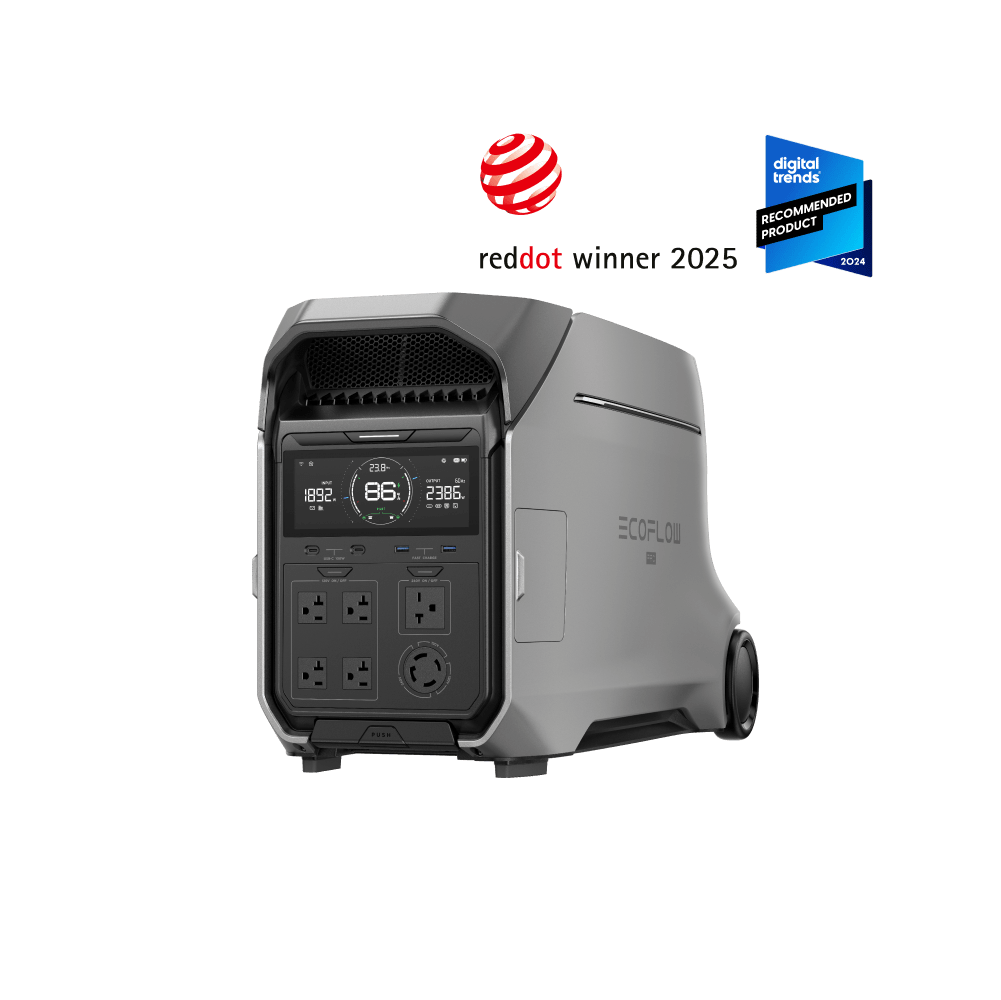
Photo: EcoFlow
None of the six stations on the generators hub outputs 240 V split-phase. When we checked on Nov 19, 2026, Amazon had no buy box for it and EcoFlow’s store showed it sold out. Native 120/240 V, 4000 W continuous, 4096 Wh LFP, with a NEMA L14-30R and 6-20R on the box. It is still a suitcase, not a hardwired house: EcoFlow says its Smart Home Panel 2 or transfer switch needs a qualified electrician, so budget for that install. (EcoFlow DELTA Pro 3 specs and FAQ)
120 V and 240 V are not simultaneous. EcoFlow’s FAQ: two AC buttons; pressing 120 V powers the 5-20R + TT-30 and turns 240 V off; pressing 240 V powers L14-30 + 6-20R and turns 120 V off. A 240 V compressor or well pump still has inrush this site has not measured.
AC: 4000 W continuous, 6000 W with X-Boost, surge 8000 W, 120/240 V ~ 16.7 A 60 Hz, 4000 W total. 120 V outlets: 4 × NEMA 5-20R 20 A + 1 × NEMA TT-30R 30 A. 240 V outlets: 1 × NEMA 6-20R 16.7 A; 1 × NEMA L14-30R 16.7 A (120/240 V). Solar: 2600 W total, 2 ports — High-PV 30–150 V, 15 A, 1600 W max; Low-PV 11–60 V, 20 A, 1000 W max. Cycle rating: 4000 cycles to 80% (Specs; FAQ restates 4000 cycles at a moderate charge/discharge rate of 0.5C/0.5C / 25 °C, over 80% SoH — state of health, how much capacity is left). UPS 10 ms. Weight 51.5 kg (113.54 lb); size 16.16 × 13.43 × 27.28 in. Battery pack IP65; main unit IP20 (FAQ: indoor or sheltered outdoor).
Expandable — do not collapse 12 / 36 / 48 kWh. Specs table: single unit 12 kWh (2 × DP3 Extra Battery). System* 36 kWh (6 × DP3 Extra Battery); up to 48 kWh**. Footnotes: *pair 3 inverters with Smart Home Panel 2; **requires 3 × DELTA Pro 3, 3 × extra batteries, 3 × Smart Generator 4000, 1 × Smart Home Panel 2 — sold separately. Extra-battery FAQ: DELTA Pro Smart Extra Battery is compatible with DELTA Pro 3 (firmware). DELTA Pro 3 Extra Battery is not compatible with original DELTA Pro. DELTA Pro 3 main unit is not compatible with DELTA Pro main unit or DELTA Pro Ultra.
Warranty, in plain terms: EcoFlow’s warranty policy lists 5 years for the DELTA Pro 3. The product page splits that into 3 years standard plus 2 more when you register in the EcoFlow app. Register it and you’re covered for five.
Stock at EcoFlow and Amazon doesn’t always match, so check both. EcoFlow’s page still mentions the §25D home energy tax credit, but don’t count on that credit for a 2026 purchase; see ITC.
| Claim | Number | Source |
|---|---|---|
| Chemistry | LFP | EcoFlow US Specs |
| Capacity | 4096 Wh | same |
| AC output | 4000 W continuous; 6000 W with X-Boost; surge 8000 W; 120/240 V ~ 16.7 A 60 Hz, 4000 W total | same |
| 120 V outlets | 4 × NEMA 5-20R 20 A + 1 × NEMA TT-30R 30 A | same |
| 240 V outlets | 1 × NEMA 6-20R 16.7 A; 1 × NEMA L14-30R 16.7 A (120/240 V) | same |
| Simultaneous 120 V + 240 V | No (two AC buttons; one bank on, the other off) | Manufacturer FAQ |
| Solar input | 2600 W total, 2 ports. High-PV 30–150 V, 15 A, 1600 W max. Low-PV 11–60 V, 20 A, 1000 W max | Specs |
| Cycle rating | 4000 cycles to 80% (FAQ: 4000 cycles at a moderate charge/discharge rate of 0.5C/0.5C / 25 °C, over 80% SoH — state of health, how much capacity is left) | Specs + FAQ |
| UPS / transfer | 10 ms | Specs |
| Weight / size | 51.5 kg (113.54 lb); 16.16 × 13.43 × 27.28 in | Specs |
| IP | Battery pack IP65; main unit IP20 (indoor or sheltered outdoor) | Specs + FAQ |
| Expandable | Single unit 12 kWh (2 × DP3 Extra Battery). System* 36 kWh; up to 48 kWh**. Footnotes on the Specs table — do not collapse 12 / 36 / 48 | Specs table footnotes |
| Warranty | Policy table 5 years; product page says 3 + 2 with app registration | US Limited Warranty Policy + product page |
240 V Amazon alt (not the pick): Anker SOLIX F3800. Anker lists 3840 Wh, 6000 W, 120 V/240 V, NEMA 14-50 and L14-30, solar up to 2400 W (dual 1200 W), expandable to 53.8 kWh claimed, UPS <20 ms, net weight 60 kg / 132.3 lb, LiFePO4 in the user guide. Heavier than DELTA Pro 3; higher continuous watts on those 240 V ports. It’s here as a different-brand option, not a second “best.” Check the F3800 Plus at Anker
Brand differences
Search traffic wants a logo winner. The useful differences are warranty channel, whether the pack can grow, which solar plug it takes, and whether 240 V exists on the suitcase. Extra batteries and native cables are brand-proprietary. A Jackery DC8020 panel will not magically become an EcoFlow extra battery.
Warranty (US, as printed — do not flatten 2+1 with 5)
| Brand / SKU in this hub | What the manufacturer actually prints | Source (opened 27 Aug 2026 unless noted) |
|---|---|---|
| EcoFlow DELTA 3 | 5 years | US warranty policy table, DELTA 3 Series row |
| EcoFlow RIVER 3 | 24 months | US warranty policy, RIVER Series |
| EcoFlow DELTA Pro 3 | Policy table 5 years; 3 + 2 on the product page once you register in the app | Policy + product page |
| Jackery Explorer 1000 v2 | Product 3+2; Service Policy 2+1 for 1000 Series; extra years “ONLY at Jackery.com” / official + authorized | Product page + Jackery Service Policy |
| Jackery Explorer 2000 v2 | Product 3+2 / FAQ 3+2 for official / Jackery-branded / authorized dealers | Product page |
| Jackery Explorer 300 (not a pick) | Product 2+1 | Explorer 300 product page |
| Jackery renewed | 6 months | Service Policy |
| BLUETTI Elite 200 V2 | 5 years | Elite 200 V2 specs |
| Anker SOLIX C1000 Gen 2 | Registration page: registering “Activates 5-year hassle-free protection” for Anker SOLIX portable power stations; C1000 Gen 2 is on the product list | Warranty registration |
| Anker SOLIX F3800 | Same registration list (5-year portable-station sentence) | Same page |
Jackery extra years are channel-dependent. EcoFlow DELTA Pro 3 3+2 vs 5-year table is a manufacturer conflict — both are published above. Amazon buyers may not get Jackery’s extra years.
Expandability
| Brand | On-site / this-hub SKUs | Grows? |
|---|---|---|
| Jackery | 1000 v2, 2000 v2 | No. Plus / HomePower lines are the expandable Jackery path, but we haven’t picked one for this page. |
| EcoFlow | DELTA 3 | Yes, claimed to 5 kWh with listed EcoFlow extras (DELTA 3, DELTA 3 Plus, DELTA Pro 3, DELTA 2 and DELTA 2 Max extra batteries). |
| EcoFlow | RIVER 3 | No |
| EcoFlow | DELTA Pro 3 | Yes, 12 kWh single-unit / 36–48 kWh system footnotes (do not collapse) |
| BLUETTI | Elite 200 V2 | No (mfr FAQ: not expandable, no power bank mode) |
| Anker | C1000 Gen 2 | No (Anker’s comparison chart). The “C1000 + Expansion Battery” bundle is for the original C1000. |
| Anker | F3800 | Yes, claimed to 53.8 kWh (mfr F3800 page) |
Solar input + connectors
Industry MC4 ≠ Jackery DC8020 ≠ EcoFlow XT60i. An adapter is a separate SKU unless the panel box list names it. Full pairing tables: Best Portable Solar Panels for Power Stations (2026).
| Station | Solar max | Window (as documented) | Native panel connector |
|---|---|---|---|
| Jackery 1000 v2 | 400 W | Dual DC 8 mm, 16–60 V, dual 21 A | DC8020 / DC7909 — SolarSaga 200W on the panels hub |
| Jackery 2000 v2 | 400 W | Dual DC 8 mm; 11–16 V and 16–60 V, 400 W / 21 A (Tech Specs 27 Aug 2026) | Same Jackery DC 8 mm |
| EcoFlow DELTA 3 | 500 W | DC 11–60 V | XT60 / XT60i — NextGen 220W on the panels hub |
| EcoFlow RIVER 3 | 110 W | Watts only; the 11–30 V car input isn’t its solar voltage window | XT60 family; the Renogy 100W suitcase on the panels hub is the closest size match |
| EcoFlow DELTA Pro 3 | 2600 W total | High 30–150 V / 15 A / 1600 W; Low 11–60 V / 20 A / 1000 W | EcoFlow PV family (high + low ports) |
| Anker C1000 Gen 2 | 600 W | Split MPPT 11–28 V 8.2 A and 29–60 V 14.5 A | PS400 on the panels hub uses the high window (Vmp 48 V). A ~18 V 200 W panel lands in the 8.2 A slice and can clip. |
| BLUETTI Elite 200 V2 | 1000 W | 12–60 V, 20 A max | XT60 — MC4 panels need an MC4-to-XT60 cable. BLUETTI 350W on the panels hub: do not put two in series (Voc printed 33 V vs 46.5 V; two pass 60 V either way) |
| Anker F3800 | 2400 W (2 × 1200 W) | User guide: two solar inputs, firmware-dependent amp windows, 60 V class | MC4 / Anker solar leads |
A 400 W-max Jackery will clip a 600 W array. Rated panel watts are a lab figure, not what you’ll see outside. Match Voc and current to the printed window; in cold sun, Voc rises.
240 V
| Brand | Pick on this page | 240 V on one box? |
|---|---|---|
| Jackery | 1000 v2, 2000 v2 | No (120 V) |
| EcoFlow | DELTA 3, RIVER 3 | No |
| EcoFlow | DELTA Pro 3 | Yes — L14-30 + 6-20R. Not simultaneous with 120 V outlets. |
| BLUETTI | Elite 200 V2 | No (mfr spec: 120 V AC only; no TT-30) |
| Anker | C1000 Gen 2 | No (120 V) |
| Anker | F3800 | Yes — NEMA 14-50 and L14-30, 6000 W max on those ports (user guide). |
A 120 V camping station is the wrong tool for a 240 V well pump. Split-phase / hybrid-inverter / transfer-switch work is an electrician job, not this Amazon suitcase. Amazon CTAs on this page stay on the portable station.
Quiet (manufacturer dB only — this site has not metered)
- Jackery 1000 v2: 30 dB (Jackery)
- Jackery 2000 v2: <30 dB quiet mode, 45 dB full load at 1 m (Jackery)
- EcoFlow DELTA Pro 3: “as low as 30 dB” X-Quiet (EcoFlow’s marketing claim)
All four brands’ lithium stations are the indoor-safe contrast to a gas generator (no exhaust). That’s the real quiet-camping win over a motor. It isn’t a ranking of fan noise between the four brands. Anker doesn’t list a noise level for the C1000 Gen 2, so if quiet matters, check reviews first.
LiFePO4 cycle ratings are not interchangeable
Do not copy “4000 cycles to 80%” onto a Jackery. Jackery’s 70%+ end-of-test is not the same claim as EcoFlow/Anker 80%.
| SKU | Published cycle line |
|---|---|
| EcoFlow DELTA 3 | 4000 cycles to 80+% |
| EcoFlow DELTA Pro 3 | 4000 cycles to 80% |
| Anker C1000 Gen 2 | 4,000 cycles to ≥80% |
| Jackery 1000 v2 / 2000 v2 | 4000 cycles to 70%+ |
| EcoFlow RIVER 3 | 3000 cycles to 80% |
| BLUETTI Elite 200 V2 | 6,000+ cycles to 80% |
Anker C1000 Gen 2 chemistry: the Amazon listing says LiFePO4, while Anker’s own site doesn’t name it either way.
Remaining NMC Jackery SKUs — no product card
Jackery’s own chemistry table still lists Explorer 300, 500, and 880 as NMC and “Available on the official website and authorized third-party sellers.” Current v2 / Plus / HomePower rows on that table are LiFePO4. The Amazon Explorer 300 listing now calls it LiFePO4, which clashes with Jackery’s own table and its Explorer 300 page (lithium-ion, 800 cycles to 80%). Until Jackery clears that up, we don’t recommend it as an LFP pick. Buy v2 / Plus / HomePower if you want the chemistry Jackery prints as LFP on its current product pages (the 1000 v2 and 2000 v2 here). Independent LFP vs NMC cell cycling: Preger et al., J. Electrochem. Soc. (Sandia) is the place for real cycling data, not a “LFP lasts 10× NMC” rule of thumb. (Jackery chemistry table; Preger et al.)
No 30% ITC on 2026 portables
The IRS Residential Clean Energy Credit “equals 30% of the costs of new, qualified clean energy property for your home installed anytime from 2022 through December 31, 2025.” The credit is not available for any property placed in service after December 31, 2025. Battery storage (when the credit applied) had to be at least 3 kilowatt hours. Used property is not eligible. The credit is claimed for the year the property is installed, not merely purchased. (IRS Residential Clean Energy Credit, opened 27 Aug 2026)
EnergySage (updated 23 Mar 2026): §25D expired for customer-owned systems; unused 2025 credit can still carry forward; leases/PPAs may still use commercial §48E. (EnergySage)
A 2026 Jackery / EcoFlow / BLUETTI / Anker portable bought and placed in service in 2026 does not get 30% off. Even before expiry, 245 Wh and ~1 kWh stations were under 3 kWh. DELTA Pro 3 is ≥3 kWh on paper and EcoFlow still prints a §25D educational blurb — this hub does not turn that into a 2026 Amazon CTA. Family Handyman-style “eligible for 30% IRA” copy on DELTA Pro 3 is stale.
Practical notes
Certified-refurb vs marketplace used
EcoFlow’s own refurbished guide separates a manufacturer refurb (returns/demos that go through a test-and-repair line, including a battery-health / cycle-count check, sometimes a replaced pack) from “something used from another person.” EcoFlow’s own table says a good refurb warranty is often shorter than new (their example: new 2–5 years vs refurbished 90 days to 1 year). Jackery’s Service Policy is more specific on Jackery’s own channel: “A 6 month warranty on renewed Jackery products,” and Jackery’s limited warranty does not apply to any product purchased through an online auction house. Prefer a brand-renewed / manufacturer-refurb listing with a printed warranty over a third-party Marketplace “used” offer with no battery-cycle report. We haven’t inspected anyone’s refurb process ourselves. (EcoFlow refurbished guide; Jackery Service Policy)
How to pick among these four logos
- Carryable quiet camp kit, native SolarSaga cable: Explorer 1000 v2. Need more inverter watts in the same ~1 kWh class, and you accept no expansion: C1000 Gen 2.
- One typical older-fridge day in a lighter ~2 kWh box: Explorer 2000 v2. Same energy class, but you want up to 1000 W of solar in and can live without add-on batteries: BLUETTI Elite 200 V2.
- A 240 V outlet on the suitcase (welder / dryer / well-pump class): DELTA Pro 3, knowing 120 V and 240 V are mode-switched, ~114 lb, and a transfer switch is an electrician. F3800 is the heavier 240 V Amazon alt, not a second pick.
- Whole-home from a 1 kWh camping brick: no. The generators hub already forbids that, and so does this page.
Size the job in watt-hours first: How Much Solar Generator Do I Need? Then match the panel plug: Best Portable Solar Panels for Power Stations (2026).
Specs and warranty terms come from Jackery, Anker, BLUETTI and EcoFlow. We leave most prices off this page because they move daily, so tap through before you buy.
How we sourced this
This is a spec hub, not a hands-on review. We have not lab-tested or lived with these units, metered fan noise, or timed a fridge compressor. The numbers here come from the makers’ spec and warranty pages. Stock and listings change, so check before you buy.
Disclosure: As an Amazon Associate I earn from qualifying purchases. I also earn a commission from some other retailers, including Anker SOLIX, BLUETTI, and EcoFlow (through CJ). You pay the same.