Disclosure: As an Amazon Associate I earn from qualifying purchases. I also earn a commission from some other retailers, including BLUETTI and EcoFlow (through CJ) and Anker. You pay the same.
You bought a power station and a panel. Now there are two plugs that don’t match and a spec sticker full of V, A and W. This page sorts out both problems: which cable joins the two, and how many panels you can safely wire together for your station.
Everything here comes from the makers’ own spec pages and manuals, checked Nov 19, 2026. We haven’t bench-tested these setups. The math is the same math the manuals ask you to do, just written out.
Quick answer
- Almost every folding panel ends in MC4. Most stations take XT60 or XT60i (EcoFlow, Anker, BLUETTI) or DC8020 (newer Jackery). So you need one cable: MC4 to your station’s plug.
- Before you wire panels together, check two numbers: the panels’ total open-circuit voltage on a cold morning has to stay under the station’s top voltage, and the total current has to stay under its amp limit.
- Series adds volts. Parallel adds amps. Most 1 kWh stations with a 60 V input are happy with two 20-volt-class panels in series and unhappy with three.
Jump to: The one-cable picture · Plug cheat sheet · Station input table · Series vs parallel · Cold mornings · Pairing examples · Adapters · Mistakes
The one-cable picture
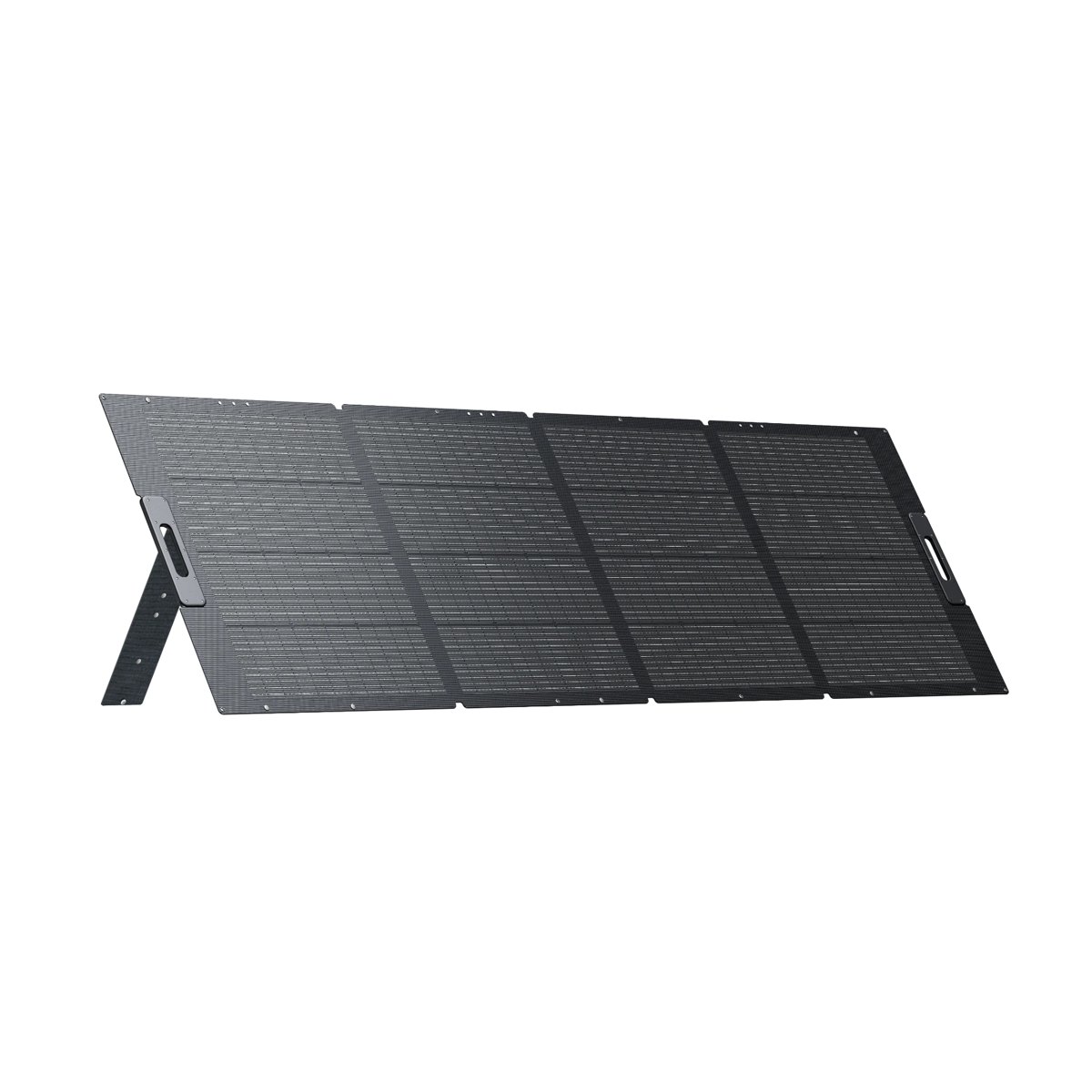
Think of it as three parts. The panel makes the power and hands it off through MC4 plugs. The station takes power in through its own solar port. The cable in the middle only changes the shape of the plug. It doesn’t add watts and it doesn’t change the voltage.
Some panels ship with the right cable for their own brand. EcoFlow’s NextGen 220W comes with an XT60i cable, and BLUETTI’s own store lists a 20 A MC4-to-XT60 cable in the box with its 350W panel. If your panel and station come from different brands, plan on buying the cable.
Plug cheat sheet
| Plug | How to spot it | Where you’ll find it | Watch for |
|---|---|---|---|
| MC4 | Round, locking, one male and one female per panel | The output leads on nearly every folding and rigid panel | Push until it clicks. Pulling it apart takes a squeeze on the tabs. |
| XT60 | Yellow, two flat-sided pins in a D-shaped housing | Solar input on BLUETTI Elite 200 V2 and older EcoFlow units | The plug is keyed for polarity, but the wire gauge decides how much current the cable can carry |
| XT60i | Looks like XT60 with a tiny third pin on the side | Solar and car input on EcoFlow DELTA 3 and Anker SOLIX C1000 Gen 2 | EcoFlow says both its XT60 and XT60i solar cables work on DELTA and RIVER units |
| Anderson Powerpole (APP) | Flat red and black blocks that slide together | Some panels, RV wiring, Jackery’s cable for the 100 Prime and 500 X | Easy to assemble backwards if you crimp your own |
| DC7909 | Round barrel, about 8 mm | Older Jackery Explorers such as the 300, 500, 880 and original 1000 | Looks almost the same as DC8020 and won’t seat in it |
| DC8020 | Round barrel, about 8 mm, wider center pin | Newer Jackery Explorers, including the 1000 v2 and 2000 v2 | A plain MC4-to-XT60 cable is no use here |
| USB-C PD | The phone-style oval port | Phone ports on some panels, input on a few small stations | USB-C PD at 20 V × 5 A is 100 W. Fine for a phone or a tiny box, not for refilling 1 kWh. |
Solar inputs on the stations we recommend
These are the stations from our best solar generators guide. The voltage window is the range the solar port accepts. The top number is the one panels must never reach, even on a frosty morning.
| Station | Solar plug | Voltage window | Max solar | Max current | Inputs |
|---|---|---|---|---|---|
| EcoFlow DELTA 3 | XT60i | 11–60 V | 500 W | 15 A (EcoFlow says keep total Isc under 15 A) | One port |
| EcoFlow DELTA 3 Plus | XT60i | 11–60 V per port | 500 W per port, 1,000 W total | 15 A per port | Two ports |
| Anker SOLIX C1000 Gen 2 | XT60i | 11–60 V in two bands | 600 W | 8.2 A from 11–28 V, 14.5 A from 29–60 V | One port |
| Jackery Explorer 2000 v2 | DC8020 (×2) | 11–60 V | 400 W total | 8 A below 16 V, 12 A per port from 16–60 V, 21 A combined | Two ports, use both |
| BLUETTI Elite 200 V2 | XT60 | 12–60 V | 1,000 W | 20 A (8.2 A below 30 V in standard mode) | One port, two strings through a parallel cable |
Two things jump out. First, every one of these tops out at 60 V, so the cold-morning check below matters for all of them. Second, the Anker and the BLUETTI give a single 20-volt-class panel much less current than you’d expect, because they cap current hard in their low-voltage band. That’s why series wiring pays off on those two.
Series vs parallel in two pictures
- Series (plus of one panel to minus of the next) raises the voltage. It needs no extra parts, since panel leads plug straight into each other. It’s the better choice when your station caps current at low voltage.
- Parallel (all plus leads together, all minus leads together) raises the current. You need a pair of Y-branch connectors or the maker’s parallel cable. It suits stations with a high amp limit and a modest voltage ceiling.
- Series-parallel means two strings of two, joined at the end. It’s how you get past 600 W on a 60 V station without breaking either limit.
- Use matching panels in any of these. BLUETTI’s manual says not to mix panel types, and that’s good advice for every brand.
Why cold mornings change the math
A panel’s open-circuit voltage (Voc on the label) is measured at 77°F (25°C). Cold cells push more voltage, not less. On a clear, frosty morning with nothing drawing power yet, the voltage can sit several volts above the label. That’s the moment a string that looked fine on paper trips the station’s overvoltage protection, or worse.
The fix is one line of math. Take the label Voc and raise it by the panel’s voltage temperature coefficient for every degree below 77°F. We use 14°F (−10°C) as the planning low, which is 35°C below the label temperature:
Cold Voc = label Voc × (1 + coefficient × 35)
Then multiply by the number of panels in series and compare with the station’s top voltage. If your winters run colder than 14°F, use your own record low.
| Panel | Label Voc | Voc coefficient | One panel at 14°F | Two in series at 14°F |
|---|---|---|---|---|
| EcoFlow NextGen 220W | 21.5 V | −0.25%/°C | 23.4 V | 46.8 V |
| Jackery SolarSaga 200W | 22 V | −0.27%/°C | 24.1 V | 48.2 V |
Three of either panel in series is already past 60 V on a warm afternoon (3 × 21.5 V is 64.5 V), so the cold doesn’t even come into it. Two in series clears 60 V with room to spare, and by our math the EcoFlow pair is still only 47.8 V at −4°F.
If your panel’s sheet gives no voltage coefficient, use a cautious 0.35% per °C. That covers most crystalline panels with a little to spare.
Step-by-step pairing examples
Each example uses a station from our generator picks. For the panels we used two brand panels with full spec sheets, the EcoFlow NextGen 220W and the Jackery SolarSaga 200W. Both were sold out at the makers when we checked, so treat them as worked examples: the same steps work for any panel once you plug in its own numbers. Our portable panel guide tracks which panels you can actually order. Bars show how close each setup runs to the station’s limits. Green is inside the limit. Red is over.
1. EcoFlow DELTA 3 with two panels in series
Setup: two EcoFlow NextGen 220W panels, plus to minus, into the DELTA 3’s one XT60i port with the XT60i cable that comes in the panel box.
- Volts: 23.4 V cold per panel × 2 = 46.8 V. The limit is 60 V, so there’s 13 V of headroom.
- Amps: series doesn’t add current, so it stays at 12.4 A. EcoFlow’s limit is 15 A.
- Watts: 2 × 220 W = 440 W of panel against a 500 W input.
- Result: works. By simple arithmetic (1,024 Wh ÷ 440 W) that’s a little over two hours of ideal sun to fill it. Real days run longer.
Now try the same two panels in parallel. Volts drop to 23.4 V, which is fine, but current doubles to 24.8 A. EcoFlow’s manual says total short-circuit current must stay within 15 A to avoid damage, so parallel is out on this station.
DELTA 3 on Amazon DELTA 3 at EcoFlow See panels you can order
2. Anker SOLIX C1000 Gen 2 with two panels in series
Setup: two 20-volt-class panels like the NextGen 220W in series, then into the C1000 Gen 2’s XT60i port. Anker puts no solar cable in this station’s box, so a panel with bare MC4 leads needs an MC4-to-XT60 cable.
- Why not one panel? One NextGen 220W works at about 18.4 V. That lands in Anker’s 11–28 V band, where current is capped at 8.2 A. 18.4 V × 8.2 A is about 151 W, so a 220 W panel gives you well under 220 W even in perfect sun.
- Volts in series: working voltage doubles to about 36.8 V, which moves you into the 29–60 V band. Cold Voc is 23.4 V × 2 = 46.8 V, under 60 V.
- Amps: 11.9 A working current, under the 14.5 A cap for that band.
- Watts: about 440 W into a 600 W input.
- Result: works. Two panels in series give about 440 W, versus about 151 W from one panel on its own.
Don’t add a third panel in series. Three of these make 64.5 V before the cold even starts. We’d stop at two in series here.
C1000 Gen 2 on Amazon C1000 Gen 2 at Anker 10 ft MC4-to-XT60 cable See panels you can order
3. Jackery Explorer 2000 v2 with one panel per port
Setup: two Jackery SolarSaga 200W panels, one into each of the 2000 v2’s DC8020 ports with the solar charging cable from each panel box.
- Volts: one panel per port, so 24.1 V cold. Nowhere near 60 V.
- Amps: 11.5 A working current per port, under Jackery’s 12 A per port. Together that’s 23 A of panel current against a 21 A combined limit, so the station trims a little at high noon.
- Watts: at about 18 V working voltage, the 21 A combined cap works out to roughly 380 W in strong sun, close to the 400 W total.
- Result: works, and you need both ports to get there.
Using another brand’s MC4 panel instead? You need an MC4-to-DC8020 adapter for each port, and the same checks apply: under 60 V cold, and under 12 A of working current per port. A plain MC4-to-XT60 cable won’t fit.
Explorer 2000 v2 on Amazon MC4-to-DC8020 adapter See panels you can order
4. BLUETTI Elite 200 V2 in series, and when two strings work
Setup: two 20-volt-class panels in series, then one MC4-to-XT60 cable rated for at least 20 A into the station’s XT60 port.
- Volts: 46.8 V cold for a pair of NextGen 220W panels, under 60 V.
- Amps: 11.9 A working current, under BLUETTI’s 20 A.
- Watts: about 440 W into a 1,000 W input, so there’s room to grow.
- Result: works. A single 20 V panel on this station runs under 30 V, where BLUETTI’s standard mode caps current at 8.2 A, so the series pair does a lot more than twice the work of one panel.
To use more of that 1,000 W, BLUETTI’s manual shows two strings of two panels joined in parallel with its parallel cable or a pair of Y-branch connectors. Its example uses 200 W panels that make about 10 A each, which adds up to 20 A, right at the limit. Two strings of 12 A panels like the NextGen would be about 23.8 A, over the line. So two strings only make sense with panels that run near 10 A or less.
Elite 200 V2 at BLUETTI 10 ft MC4-to-XT60 cable Y-branch connectors See panels you can order
Adapters worth owning
Only buy the one your station’s port calls for. Ratings below are what each Amazon listing states. Prices change often, so the buttons show today’s price instead of us printing one.
| Adapter | Buy it if | Skip it if | Link |
|---|---|---|---|
| 10 ft MC4-to-XT60, 12 AWG (listed at 30 A) | Your station has an XT60 or XT60i port and the panel sits out in the yard | You own a Jackery with DC8020 ports | Check price on Amazon |
| 2 ft MC4-to-XT60, 12 AWG (listed at 30 A) | The panel can sit right next to the station | You need any real distance | Check price on Amazon |
| COMeap MC4-to-8 mm cable with DC8020 tip (listed at 15 A) | You own a DC8020 Jackery and a non-Jackery panel | Your panel is a Jackery SolarSaga that already fits | Check price on Amazon |
| Renogy MC4 Y-branch pair | You’re wiring two panels or two strings in parallel | Your station caps current low, like the DELTA 3 at 15 A | Check price on Amazon |
| EcoFlow Solar to XT60i cable | You want EcoFlow’s own cable for a DELTA or RIVER | Your EcoFlow panel already came with one | Check price at EcoFlow |
A note on the XT60i stations. The plain XT60 plug fits the XT60i socket because the extra pin sits off to the side. EcoFlow says its regular XT60 solar cable works on all its DELTA and RIVER units. Anker doesn’t make the same promise for the C1000 Gen 2, so if you’d rather not guess, ask Anker which cable it recommends before you buy.
Common mistakes
- Three 20-volt panels in series on a 60 V station. It’s over the limit before sunrise. Two is the ceiling for these panels.
- Doing the voltage math in July. A string that reads 58 V on a warm day can cross 60 V on a frosty one. Use the cold number.
- Paralleling panels into a low-amp input. On the DELTA 3, two 220W panels in parallel make 24.8 A against a 15 A limit.
- Running one 20 V panel on a station with a low-voltage current cap. On the Anker C1000 Gen 2 and BLUETTI Elite 200 V2 that panel gets held to 8.2 A. Wire two in series instead.
- Buying an MC4-to-XT60 cable for a Jackery. Newer Explorers take DC8020. Older ones take DC7909. Neither is XT60.
- Chaining adapters. Every extra joint adds a little resistance and heat. One cable of the right type and gauge beats a pile of short ones.
- Mixing panel models in one string. The weaker panel drags the pair down, and the voltage math gets murky.
- Crimping your own Anderson or barrel leads backwards. Check plus and minus with a meter before the first plug-in.
Quick questions
Do I need a charge controller between the panel and the station?
No. Each of these stations has a solar charge controller built in. The controller that comes in some suitcase kits is for charging a 12 V battery directly. For a power station, you skip it and go panel to cable to station.
Can a panel with more watts than my station allows hurt it?
Extra watts on their own aren’t the danger. The station only draws what it can use. Voltage is the one that does damage, which is why the cold-morning check comes first. Current comes second, and EcoFlow treats its 15 A figure as a hard limit.
Does a longer cable cost me watts?
A little. Thicker wire loses less. For runs past 10 feet, 12 AWG or heavier is a sensible floor at these currents.
Keep reading
- Best Portable Solar Panels for Power Stations: which panels you can order today
- Best Solar Generators and Portable Power Stations: the stations in the table above, with Buy or Skip verdicts
- How Much Solar Generator Do I Need?: size the battery before you size the panels
- Portable Power Station Size Calculator
- Power station accessories: cables, covers and expansion batteries
- Wrong Plug, Right Watts: the story version of this page
See the panel picks See the station picks
Where the numbers come from
All checked Nov 19, 2026. Stations: EcoFlow DELTA 3 user manual, EcoFlow DELTA 3 Plus user manual, Anker SOLIX C1000 Gen 2 product page, Jackery Explorer 2000 v2 product page, BLUETTI Elite 200 V2 product page and user manual. Panels: EcoFlow NextGen 220W manual, Jackery SolarSaga 200W, BLUETTI 350W. Plugs: Jackery DC input guide, EcoFlow solar charging cables. The cold-morning voltages and the 151 W estimate are our own arithmetic from those figures, not test results.