How Long Will a Solar Generator Run a Fridge? (2026)
Disclosure: As an Amazon Associate I earn from qualifying purchases. Some links are affiliate links. You pay the same.
Storm’s coming. You keep opening the fridge to “check.” That is the wrong habit. You need the kitchen cold, not a science project in the vegetable drawer.
A portable solar generator — a suitcase battery with an inverter — can keep a fridge cycling through a short outage. It will not run the whole house. It will not run central air. It will not invent hours your fridge does not use.
This page is the fridge math. For overnight / full-day / multi-day kits, open Best Solar Generator for Home Backup (2026). For brand picks around 1–2 kWh, open Best Solar Generators 2026.
The four-hour clock (before any battery)
FDA food-safety guidance is blunt. Keep fridge and freezer doors closed. An unopened refrigerator keeps food cold about 4 hours. Aim for 40°F or below. If perishable food sits above 40°F for 4 hours or more, throw it out.
You’ll be checking the fridge in the dark, so keep a light that runs on store-bought batteries in the kitchen drawer. Here’s how to pick a flashlight that still works when the power’s out.
Sources: FDA power-outage food tips; FDA food and water safety during outages.
That clock is why a suitcase battery is useful. You are buying hours past that four-hour window — not a rooftop system.
Why “150 W × 24 hours” is wrong
A fridge is a motor. The compressor starts hard, then cycles off. Treating it like a constant 150 W lamp for 24 hours invents a number nobody measured.
Use daily energy (kWh/day), not a guessed running watt.
- DOE FEMP ENERGY STAR residential-refrigerator example: about 1.0 kWh/day (363.5 kWh/year).
- Oak Ridge / DOE BTO peer-review material puts a representative U.S. fridge around 1.5–2.0 kWh/day (one tested ENERGY STAR Samsung at 1.68 kWh/day).
Those are published figures, not a stopwatch test from this site. Your older top-freezer may sit toward the higher end. A new efficient unit may sit closer to 1 kWh/day.
Inverter losses mean usable AC Wh is less than the nameplate battery Wh. Do not plan as if 1024 Wh on the sticker is 1024 Wh at the wall.
Quick size chart (paper math)
Ignore surge for a moment. Ignore other loads. Rough fridge-only classes from the named kWh/day figures above:
| Station class | Nameplate Wh | Paper fit (fridge only) |
|---|---|---|
| ~1 kWh (EcoFlow DELTA 3) | 1024 Wh | About one efficient-fridge day if nothing else is running. Overnight for a thrifty fridge. Short for a hungry older fridge plus phones and lights. |
| ~2 kWh (Jackery Explorer 2000 v2 / BLUETTI Elite 200 V2) | 2042–2073.6 Wh | About one typical older-fridge day (ORNL 1.5–2.0 kWh) with a little room for phones and LEDs — or a safer overnight margin. |
| DELTA 3 + matching extra battery | ~2048 Wh combined (arithmetic) | Same ballpark as a ~2 kWh sealed pack. Extra battery does not raise the inverter watts. |
Add phones, a few LEDs, a CPAP, or a fan and those hours shrink fast. Measure your fridge with a plug-in kWh meter if you can. Guessing is how people buy the cute camping brick and cry at hour six.
Running more than the fridge? Try our portable power station size calculator. It works out watt-hours, runtime and startup surge for your whole list.
Three stations people actually point at a fridge
Specs below are manufacturer nameplate numbers already used on our hubs. We have not timed a compressor overnight in a lab. Labels: good for a night / good for a full day / if the outage may last.
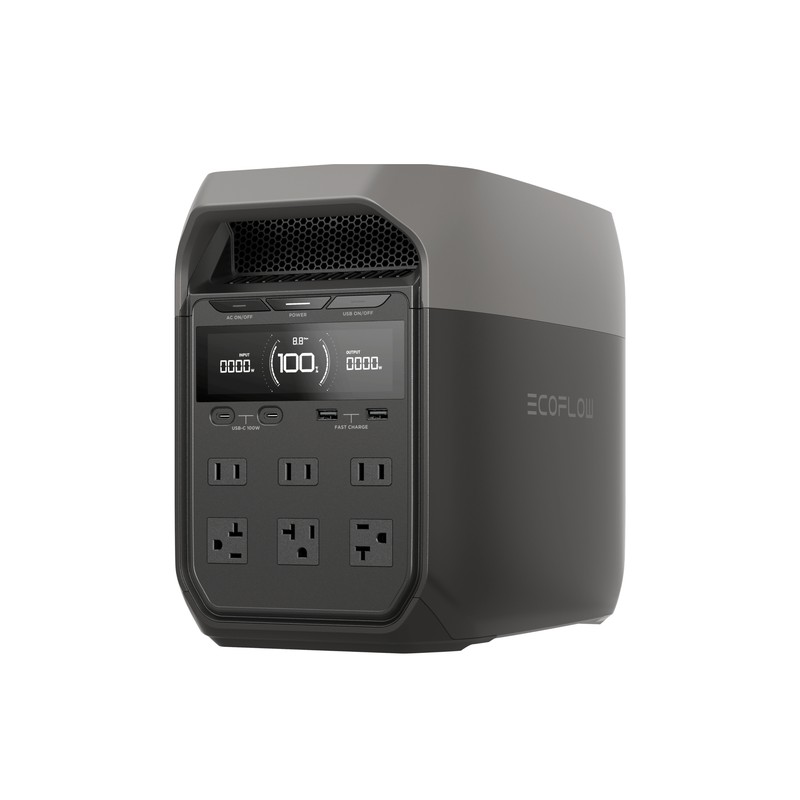
Good for a night — EcoFlow DELTA 3 (~1 kWh)
EcoFlow’s U.S. table: 1024 Wh, 1800 W continuous AC, 3600 W surge, about 27.6 lb, expandable with EcoFlow extras (claimed to 5 kWh). ~1 kWh is one efficient-fridge day on paper if nothing else runs. It is the overnight class for a thrifty fridge — not 48 hours on a typical older box.
Good for a full day — Jackery Explorer 2000 v2 (~2 kWh)
Jackery: 2042 Wh, 2200 W continuous / 4400 W surge, LiFePO4, about 39.5 lb, not expandable. Paper fit: one typical older-fridge day plus phones and a few LEDs, with little margin after losses.
If the outage may last — BLUETTI Elite 200 V2 (~2 kWh, more solar)
BLUETTI: 2073.6 Wh, 2600 W continuous, LiFePO4, about 53.4 lb, 6,000+ cycles to 80%, and up to 1000 W of solar input for day-two recharging. Same ~2 kWh class as the Jackery. It is not expandable (BLUETTI FAQ), so the extra margin comes from solar, not add-on batteries.
Can it even start the compressor?
Watt-hours answer “how long.” Continuous and surge watts answer “will it start.” A fridge compressor can demand a short surge well above its running draw. If the station browns out on startup, more Wh will not help. The DELTA 3 and Explorer 2000 v2 list surge in the thousands of watts — enough for many household fridges on paper. BLUETTI’s U.S. page lists 2600 W continuous for the Elite 200 V2 but no surge figure. Your mileage depends on the fridge. If you already own a tiny 300 W camping brick, do not expect miracles.
Day two: add panels if the outage sticks
A charged suitcase buys you the first night. Sun on day two buys you another. Match panel watts and connectors to the station. Start with Best Portable Solar Panels and the pairings on the home-backup hub.
What this will not do
- Whole-home backup
- Central air or a 240 V well pump
- Replace a rooftop battery or transfer switch for the whole panel
Portable kits also do not get the 30% residential clean-energy credit the way some rooftop gear does. Run the IRS rules on the actual product; do not assume a suitcase qualifies.
More guides
- Best Solar Generator for Home Backup (2026) — 12h / 24h / 48h kit classes
- Best Solar Generators 2026 — six current stations
- How Much Solar Generator Do I Need? — watts vs watt-hours
- Jackery vs EcoFlow vs Bluetti vs Anker
FAQ
Will a 245 Wh camping pack run a full-size fridge overnight?
No. That class is phones and lights. A full-size fridge wants roughly a kilowatt-hour class (or more) for overnight paper math.
Do I leave the fridge door shut?
Yes. FDA: keep doors closed. Every peek spends cold you paid for.
Is this a test we ran?
No. We cite manufacturer Wh, FDA’s 4-hour fridge guidance, and published kWh/day figures (DOE FEMP / ORNL ranges). Label the math untested on your exact fridge.
Should I buy gas instead?
Gas generators make sense for some people. Keep them outdoors and away from windows — carbon monoxide is not a joke. A lithium suitcase runs indoors. Different tool.
Disclosure: As an Amazon Associate I earn from qualifying purchases. Some links are affiliate links. You pay the same.
How we sourced this
FDA power-outage food-safety pages (4-hour unopened fridge; 40°F). DOE FEMP ENERGY STAR refrigerator example (~1.0 kWh/day). ORNL / DOE BTO representative fridge range 1.5–2.0 kWh/day. Manufacturer nameplate Wh for EcoFlow DELTA 3, Jackery Explorer 2000 v2, and BLUETTI Elite 200 V2 (BLUETTI U.S. spec page and manual, checked October 17, 2026). Official EcoFlow product photo. No invented prices. No hands-on overnight fridge timing claimed.